Topical Authority
Build True Topical Authority and Outrank Giants in 2026
Stop chasing isolated keywords. Leverage AI-powered topic hierarchies and SERP-based clustering to build comprehensive content hubs that consistently outrank high-authority domains.
- Structure precise Topic → Page → Keyword Hierarchies
- Spot critical Content Gaps holding back your organic growth
- Gain organic traffic up to 57% faster with high topical relevance
Open your organic search analytics dashboard and filter for your most lucrative, bottom-of-funnel conversion terms. You will likely spot a mathematical discrepancy that makes little sense under the legacy rules of SEO. A newly launched, hyper-niche website with a fraction of your total backlinks and a completely unremarkable Domain Authority (DA) is consistently pushing your massive, established domain down the page. Traditional third-party metrics fail to explain this, leaving content marketing managers scrambling to understand why raw domain strength no longer guarantees visibility. The determining factor driving this shift is Topical Authority.
Topical Authority is an SEO methodology and algorithmic evaluation that measures a website's demonstrated expertise over a specific, defined subject area. Search engines calculate this by analyzing the depth, breadth, and internal architectural interconnectedness of your content. Algorithms reward domains that comprehensively answer an entire spectrum of user intent around a core concept, rather than domains that simply target high-volume, isolated keywords with disconnected blog posts.
This structural evaluation differs entirely from legacy link-based metrics. It explains exactly how a lean, highly focused team can systematically dismantle the search dominance of massive enterprise competitors. This is the reality playing out across Google's 2026 search engine results pages (SERPs) every single day.
For nearly two decades, the standard organic growth playbook rarely deviated. Content teams would identify a high-volume keyword string, commission a 2,000-word post from a generalist writer, inject the exact-match keyword into the headers, point a handful of internal links at the URL, and rely on the site's overall DA to push it to page one. High domain rating acted as an impenetrable protective moat for older websites. That moat has completely dried up. Search engines no longer retrieve and rank isolated keyword strings. They retrieve, map, and rank entities and the semantic relationships between them.
Proving semantic expertise through a tightly interconnected web of topic clusters is the only scalable, algorithm-resistant path to securing long-term organic market share. Transitioning your entire operation from a reactive, keyword-chasing content treadmill to a structured, entity-driven topical architecture requires a fundamental tear-down of how you plan, write, and link your assets.
To execute this transition effectively, this guide details a practitioner-level, 5-step framework. You will learn exactly how to move from legacy keyword content to a topics-first methodology that mathematically proves your relevance to search crawlers. Explore our complete SEO Content Strategy to map out exactly where building topical authority fits into your broader quarterly growth initiatives.
What is Topical Authority?
Compare a massive international news publication to a peer-reviewed cardiology journal. The news site has immense global popularity, traffic, and generalized trust. The medical journal has a fraction of the audience, but it holds an undisputed, specialized academic credential. When a user queries a highly complex question about ventricular arrhythmias, search algorithms mathematically favor the credentialed specialist over the popular generalist.
Google's transition toward this specialist-first model traces back to a specific architectural overhaul. The foundation was poured in 2012 with the launch of the Google Knowledge Graph. Before this update, the algorithm essentially operated as a digital librarian matching the exact characters typed into a search box to the exact characters printed on a webpage. The Knowledge Graph fundamentally changed this by introducing "entities"—mapping the real-world relationships between concepts, organizations, people, and objects.
Operating in this entity-first environment requires precise distinctions between three closely related industry concepts that practitioners often incorrectly use interchangeably:
- Semantic SEO is the daily, tactical practice of structuring and writing content so that it optimizes for these entities and their underlying meaning, rather than focusing on exact-match phrase repetition.
- Topical Relevance is the micro-level, localized measurement of how accurately a specific paragraph or individual URL relates to the precise intent of the user's search query.
- Topical Authority is the macro-level result. It is the aggregate trust search engines assign to your domain after you successfully execute semantic SEO and prove topical relevance across hundreds of interconnected URLs within your website infrastructure.
Skeptics often dismiss this concept as another theoretical SEO framework built on agency guesswork and correlation studies. Public signals and internal data leaks explicitly confirm otherwise. The importance of localized semantic relevance over broad domain authority was exposed as a core architectural pillar in the recent Department of Justice trial exhibits, which provided an unfiltered look at Google's actual ranking systems.
Consider the mechanics of how this plays out in a live SERP environment. A large, generalist SaaS company publishes a single, well-researched guide on "B2B payment gateways." In a vacuum, it ranks quickly on page one because the domain is strong and the page loads fast. However, a dedicated fintech startup decides to target the exact same vertical. They do not publish one guide; they publish a tight, structured cluster of 35 interconnected articles. These articles answer highly specific, granular sub-questions about high-risk merchant accounts, API payload security, and chargeback fraud prevention.
As Google's crawlers process the fintech site, the Knowledge Graph maps the dense, intersecting relationships between all 35 entities. The algorithm categorizes the fintech domain as the definitive, credentialed expert for the "payment gateway" entity neighborhood. Slowly but permanently, the search engine demotes the generic SaaS post. Grasping this mechanical difference allows lean marketing teams to bypass expensive link-building arms races and steal market share directly from industry giants through sheer structural density.
Keyword-First vs. Topic-First SEO Strategies
| Strategic Factor | Keyword-Driven SEO | Topic-Driven SEO |
|---|---|---|
| Primary Focus | Individual high-volume search terms | Comprehensive coverage of a specific entity or subject area |
| Content Architecture | Isolated pages targeting isolated phrases | Interconnected clusters mapped via a structured Topic → Page → Keyword Hierarchy |
| Competitive Strategy | Relying on raw domain authority and link-building budgets | Building Knowledge Graph associations to outrank larger, generic domains |
| Traffic Trajectory | Linear growth, highly dependent on continuous external link acquisition | Compounding growth; high authority pages gain traffic roughly 57% faster (Graphite research) |
| User Journey | Matching exact phrasing in titles to capture isolated queries | Using Search Intent Detection to serve relevant answers across the entire buying cycle |
Why Topical Authority Matters for E-E-A-T and Search
Your Chief Marketing Officer calls an impromptu meeting. They spent the morning testing the newest integrated LLM chat features and watching AI Overviews aggressively push traditional organic blue links entirely beneath the fold. They have one question: How are we defending our pipeline against this?
Topical authority is your direct defense mechanism. The rapid proliferation of AI Overviews and generative chat interfaces is permanently reshaping how users extract information from search engines. To protect your organic pipeline, you must demonstrate to leadership that deep, entity-mapped topical coverage is the exact technical requirement for your content to become the source material these AI models cite.
When modern generative search systems formulate answers, they do not invent facts from the ether. They rely on an architectural framework called Retrieval-Augmented Generation (RAG). RAG systems operate in two distinct phases: first, they retrieve the most authoritative, factually dense documents related to the user's prompt from an external database (the search index); second, they pass those specific documents to the LLM to generate the conversational response. The retrieval phase explicitly filters for topical depth and entity density. If your website consists of shallow, isolated blog posts lacking an interconnected semantic structure, the retrieval system simply bypasses your domain. You will not be cited.
Constructing this level of depth requires a fundamental operational shift in your content production pipeline. You must pitch leadership on the necessity of hiring actual Subject Matter Experts (SMEs) instead of relying on low-cost, generalist freelance writers. Finance departments naturally push back against higher per-word costs, but the author behind the text now carries equal weight to the text itself.
Examine the actual search quality evaluator guidelines used by human quality raters. The document uses the word 'creator' 146 times, placing immense weight on the real-world background of the person writing the article. More importantly, the E-E-A-T framework mentions 'trust' 177 times, while mentioning 'authoritativeness' only 10 times. Independent E-E-A-T analyses verify this hierarchy: Trust is the central pillar, and Trust is established by demonstrable, real-world experience.
Generalist writers rely on researching page-one search results and rewriting the consensus. They lack the localized, nuanced knowledge required to introduce new entities, mention highly specific industry tools, or articulate complex workflows. Search engines easily identify this consensus-regurgitation and filter it out of RAG retrieval.
Use Competitor Content Analysis to definitively prove this necessity to your executive team. Run an entity extraction on the current number-one ranking URL for your most valuable keyword. Map out the exact structural formats, the specific missing questions they answer, and the proprietary data they cite. Presenting leadership with the undeniable depth embedded in the winning result reframes the budget request for SMEs. It stops being viewed as a bloated marketing expense and becomes a strict technical requirement for competitive parity. Aligning credentialed authors with a mathematically sound topic map future-proofs your digital footprint against both core algorithm updates and the rapid evolution of generative search interfaces.
Content Clustering & Internal Linking
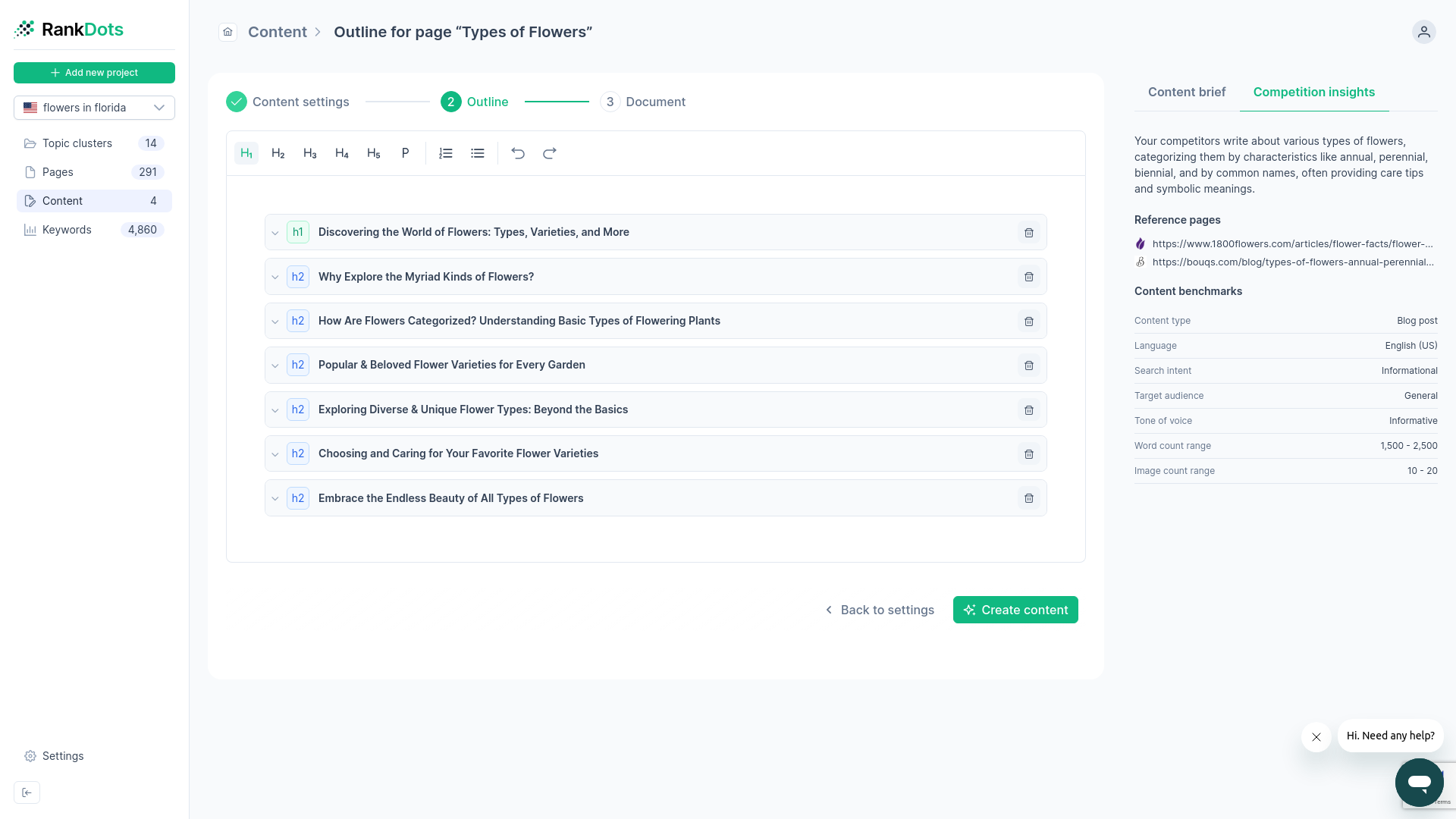
Securing budget for SME-driven content establishes the raw material; executing your strategy relies entirely on how you structurally connect that expertise across your website infrastructure.
Imagine taking over an underperforming company blog. You pull an export from your SEO software and find yourself staring at a spreadsheet containing 500 loosely related target keywords. The sheer volume creates immediate paralysis. You have no concrete data dictating how many pages to build, which keywords belong together, or how deep a single cluster needs to go to trigger algorithmic trust.
Mathematical consistency dictates the baseline architecture: a highly effective topic cluster typically requires a central pillar page supported by 10 to 30 highly specific subtopic pages. Building topical authority demands comprehensive coverage across this cluster, explicitly prioritizing both horizontal breadth and vertical depth. You cannot simply string together ten articles that happen to mention similar phrases. You must map specific URLs to specific search intents with surgical precision.
Historically, SEOs manually grouped keywords into subtopics based on intuition. This subjective approach frequently fails because human categorization rarely aligns with how Google's machine-learning algorithms cluster semantic relationships. To eliminate guesswork, rely on SERP-based Keyword Clustering. This process analyzes real-time Google search results to identify URL overlap, automatically grouping queries that share the exact same user intent.
If Google currently ranks the exact same URLs for the queries "warehouse inventory software" and "warehouse stock management tools," those two keywords share an intent profile and belong on the same URL. If the ranking URLs differ by more than 60%, the intents diverge, requiring two distinct subtopic pages within your broader cluster.
Quick Reference: Keyword-First vs. Topic-First Architecture
| Dimension | Keyword-First Approach | Topic-First Approach |
|---|---|---|
| Focus | Isolated high search volume text strings | Semantic entity relationships and precise user intent |
| Structure | Flat, disconnected chronological blog posts | 1 comprehensive Pillar supported by 10-30 deep subtopics |
| Creation | Guessing query intent based on phrasing | Real-time SERP overlap validation and mathematical clustering |
| Goal | Forcing one URL to rank for one specific term | Elevating the aggregate Share of Voice for the entire cluster |
Assume you successfully map, write, and launch a technically perfect cluster of 20 new articles. The SMEs delivered exceptional nuance, but 60 days post-launch, organic traffic remains entirely flat. Search engine crawlers are clearly indexing the URLs but failing to understand the semantic relationship between your 20 new pages.
This failure occurs when teams neglect the connective tissue. Strategic internal linking within your topic clusters acts as the physical signaling mechanism that dictates structure and relevance to search engine crawlers. Internal links serve a dual purpose: they guide users deeper into your funnel, and they act as literal pathways passing PageRank and semantic context throughout your domain architecture.
Backlinks still dictate the initial trust velocity of a cluster, but their application has changed. Instead of running expensive, decentralized outreach campaigns to build links to every single long-tail subtopic page, a structured cluster allows you to focus all link acquisition strictly on your comprehensive pillar page. The internal linking architecture then acts as a closed-loop irrigation system. It captures that inbound PageRank at the pillar level and funnels it down to the hyper-specific subtopic pages identified by your Long-Tail Keyword Finder.

Execution requires strict formatting rules. Every single subtopic page must link back to the central pillar page. Simultaneously, the pillar page must link out to all 15 or 30 subtopics. You must completely eradicate generic anchor text like "read more," "click here," or "learn more about this topic."
Instead, mandate exact-match or highly descriptive semantic anchors. If linking to your subtopic on barcode scanning, use "enterprise barcode scanning software integrations" as the anchor text. This injects the exact entity relationship directly into the Knowledge Graph. When Google's crawlers hit this bidirectional, tightly woven web of internal links, they mathematically verify the architectural depth of your cluster, rapidly elevating the domain's perceived expertise for that exact vertical.
Step-by-Step Implementation Strategy
Understanding the mechanics of clusters and PageRank distribution prepares you for the actual work. Now you must apply this rigid methodology to a messy, real-world domain.
You begin by auditing the company's legacy blog index. Pulling years of historical data from analytics platforms and a wayback machine alternative, a glaring issue emerges. You uncover hundreds of orphaned articles entirely disconnected from your core product offering. Most were published years ago simply to chase trending news or loosely related top-of-funnel traffic. Deleting published content terrifies marketing executives who associate high page counts with high value. But keeping these irrelevant, low-traffic pages actively dilutes your domain's topical focus. Search engines struggle to identify your core expertise when half of your indexed URLs cover tangential, unrelated subjects.
Pruning this dead weight directly improves a website's overall topical authority and aggregate organic traffic metrics. Case studies from enterprise domains like IBM and Progressive demonstrate that aggressively deleting or consolidating up to 40% of a bloated index forces Google to re-evaluate and elevate the remaining, highly relevant core pages. You cannot build a clean semantic architecture on top of a disorganized foundation.
To operationalize this transformation, replace ad-hoc content requests with a strict, repeatable workflow. Follow this comprehensive 5-step implementation strategy to convert a scattered content index into a dominant, high-ranking topical fortress.
1. The Content Audit and Pruning Phase
Do not write a single new brief until you evaluate the existing index. High-DA sites consistently suffer from legacy bloat. To operationalize the cleanup process without deleting valuable assets, apply a strict, binary pruning framework to every published URL.
Decision Framework: Pruning for Topical Relevance
-
Condition A: The page drives consistent, qualified organic traffic AND closely aligns with a core product topic. Action: Keep the URL and update the internal links to integrate it into your new cluster map.
-
Condition B: The page drives high vanity traffic BUT has zero semantic relevance to your core product. Action: Redirect (301) the URL to the homepage or a top-level category page. The traffic is useless for conversion, and the topical dilution actively suppresses rankings for your actual money pages.
-
Condition C: The page drives zero traffic, has zero backlinks, AND covers an irrelevant topic. Action: Delete the URL entirely and serve a 410 (Gone) status code to force Google to drop it from the index immediately.
-
Condition D: The page drives zero traffic BUT covers a highly relevant core topic. Action: Consolidate it. Extract any valuable paragraphs, 301 redirect the URL to your main pillar page, and eliminate the cannibalization.
2. SERP-Based Cluster Mapping
With the index cleaned, you can map the new architecture. The outdated method involved exporting thousands of rows from a traditional Keyword Discovery Tool and manually grouping phrases based on gut instinct. This forces unnatural relationships. Furthermore, relying entirely on historical search volume creates blind spots; Google confirms that 15% of daily searches have never been seen before. You cannot build a strategy purely around exact-match historical strings.
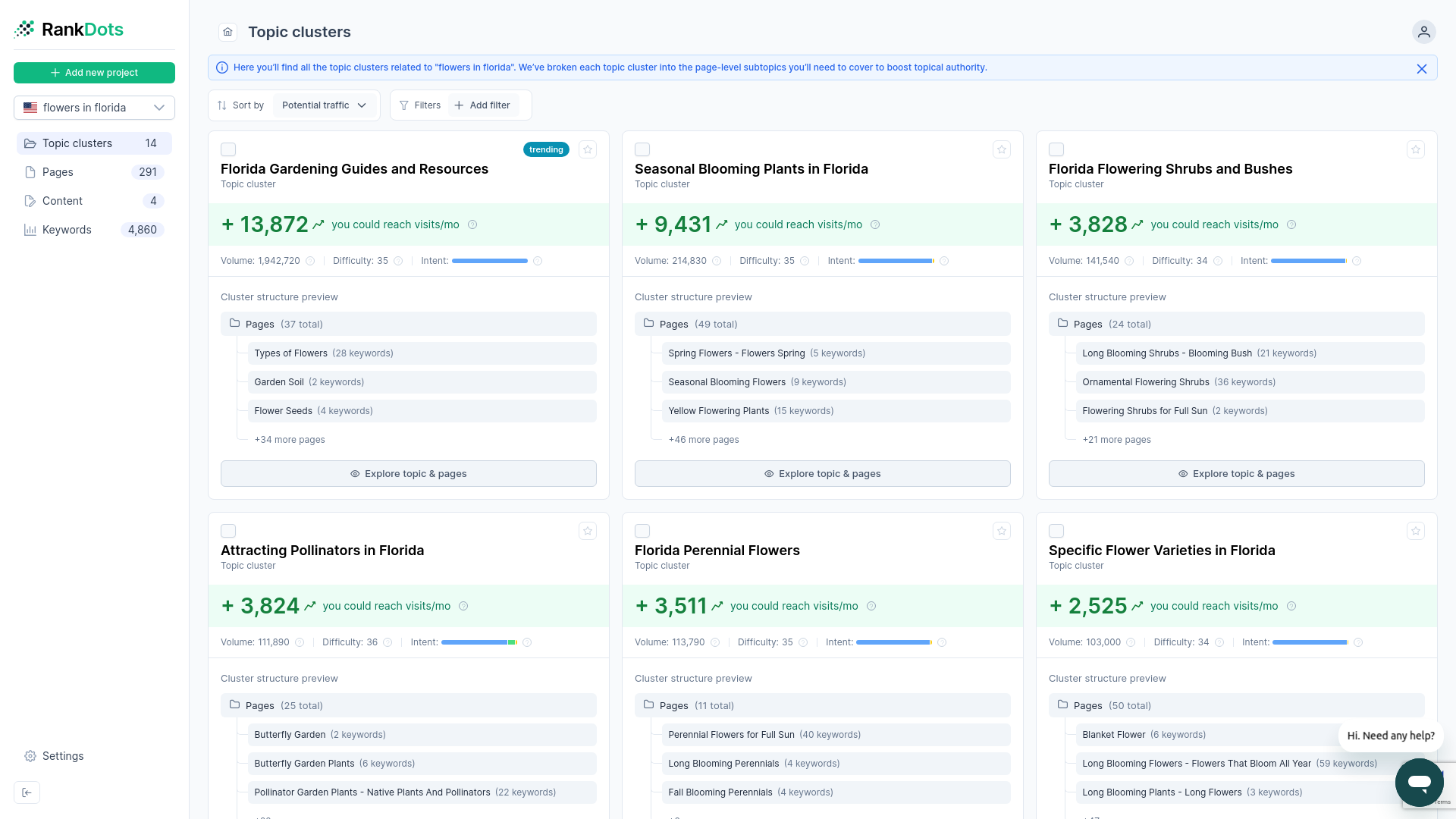
Instead, feed your core terms into a tool that utilizes real-time Keywords Clustering. This mathematically groups your target queries based on current SERP overlap. Once the software defines the clusters, manually assign a primary search intent to each group: Informational, Navigational, Commercial Investigation, or Transactional. Categorizing intent prevents your team from wasting $1,000 on a 3,000-word informational pillar page for a query where Google clearly prefers a lean, transactional product layout.
3. Executing the Topic → Page → Keyword Hierarchy
Scaling a content calendar across multiple freelance writers or internal SMEs frequently leads to keyword cannibalization. This occurs when content operations lack a central, restrictive source of truth dictating exactly which URLs target which specific terms.
Implement a strict Topic → Page → Keyword Hierarchy. This structural framework operates as your master database, ensuring every new asset naturally slots into the overarching cluster without stepping on existing pages.
- Topic Level: The broad macro-category governing the cluster (e.g., "Warehouse Logistics Operations").
- Page Level: The exact URL designated for creation (e.g., The pillar page for "Warehouse Setup Workflows").
- Keyword Level: The specific, mathematically clustered terms assigned exclusively to that single URL.
Enforcing this rigid architecture guarantees that your writers never overlap their focus. It prevents your own pages from competing against each other and eating up valuable crawl budget.
4. Briefing for Sub-Questions, Not Word Counts
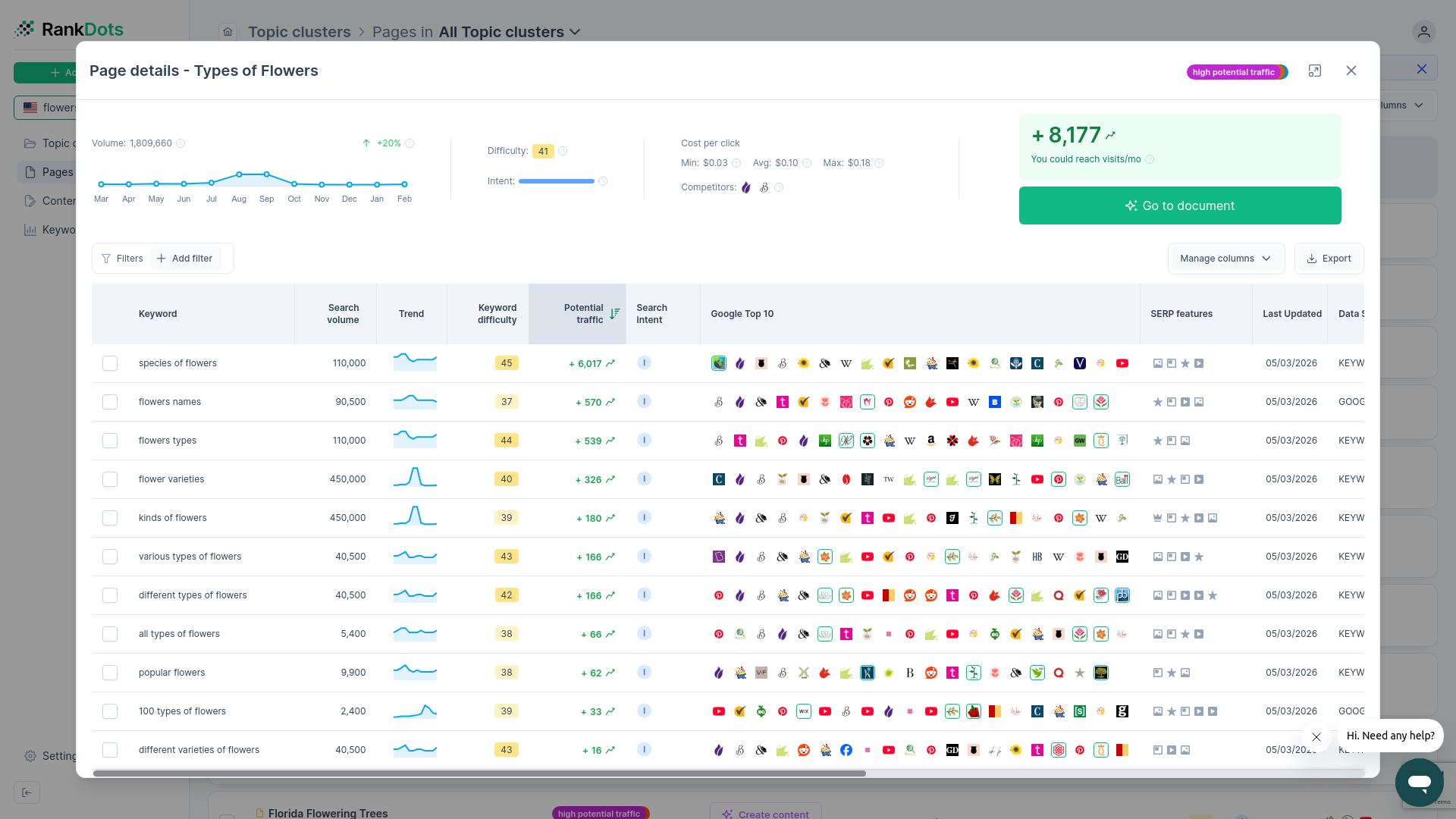
Content depth requires answering highly specific sub-questions and matching user intent. It has absolutely nothing to do with hitting arbitrary word counts. A bloated, 3,500-word article filled with repetitive transitions will always lose to a dense, 1,200-word asset that directly solves the user's problem using expert insight and proprietary data.
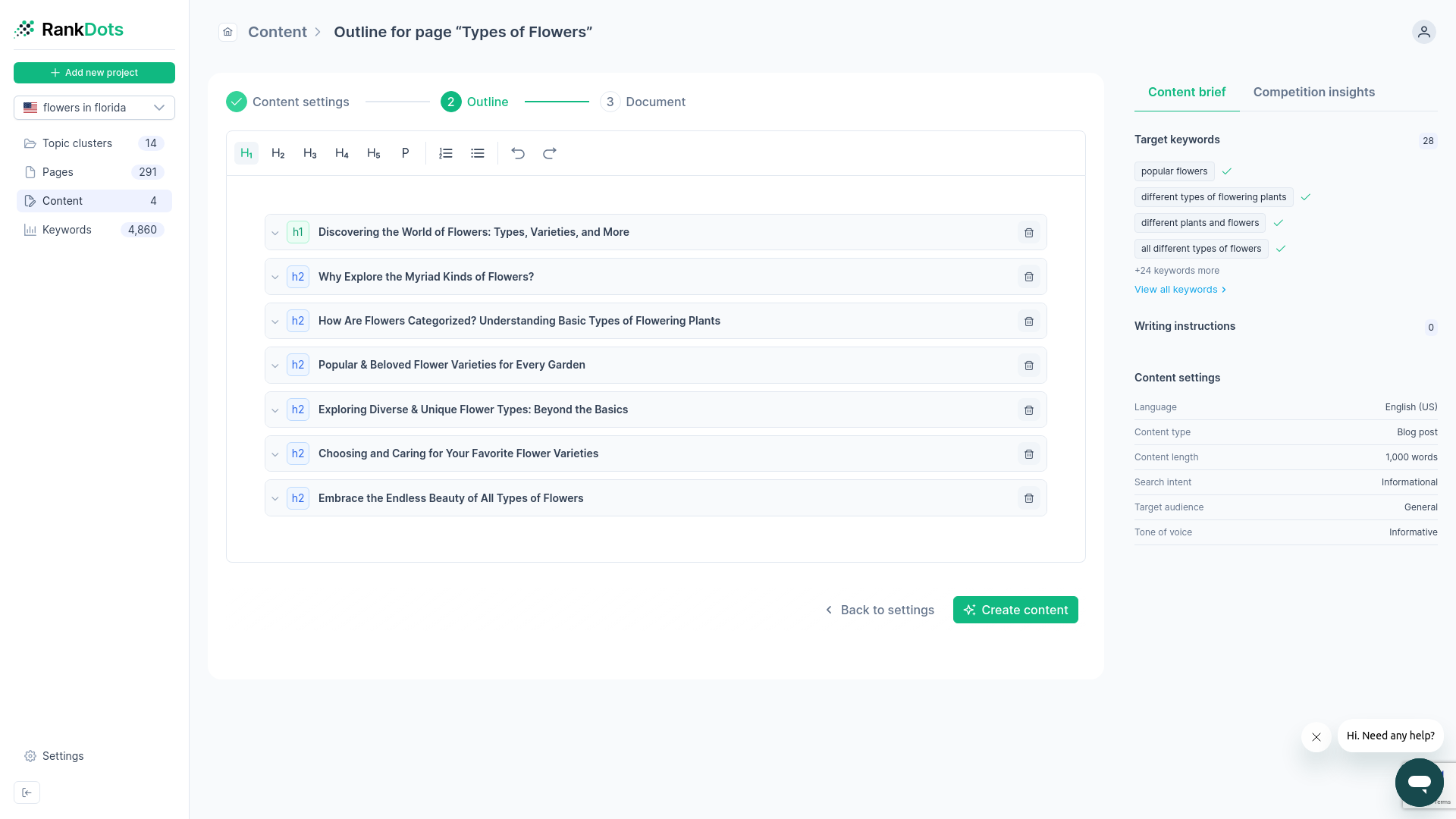
When generating AI Content Briefs, mandate precise structural formats based on the required intent. If the target query implies a step-by-step process, the brief must require an ordered HTML list. If the query requires a software comparison, the brief must mandate an HTML table. Search engines rely heavily on these structural elements to extract answers for featured snippets and AI Overviews. Matching the physical format of the intent is a primary relevance signal.
Cluster Launch Verification Checklist:
- Every clustered keyword maps strictly to one URL to completely eliminate cannibalization.
- The main pillar page links out to all 10-30 subtopics using exact-match or semantic entity anchor text.
- Every single subtopic page links back to the central pillar page.
- You have run Content Gap Identification against the top three ranking competitors to ensure your brief includes missing entity mentions.
- The content layout formats perfectly match the inferred intent of the SERP.
5. Measuring Aggregate Cluster Share of Voice (SOV)
Tracking isolated daily fluctuations for individual keywords is a fundamentally flawed reporting metric. A specific URL might drop from position two to position four for a high-volume vanity term, but simultaneously gain page-one rankings for fifty new long-tail variations. This scenario results in a massive net increase in qualified traffic, yet a keyword-first dashboard would flag it as a failure.
Shift your executive reporting entirely to aggregate cluster Share of Voice (SOV). Calculate the total combined search volume of your entire clustered keyword set. Then, measure exactly what percentage of those potential clicks your domain actually captures. This metric proves digital market dominance to leadership using business terminology they inherently understand.
Executing this strict, five-step architecture yields rapid, undeniable results. Gravitate Design published a case study demonstrating that properly restructuring a flat blog into a true, interconnected topic cluster increased an Auto Dealer Bond company's daily organic traffic from 55 visits to 125 visits within a single 24-hour period post-indexation. Pivoting from an isolated keyword strategy to a mapped, expert-driven topical architecture remains the single most profitable SEO investment a business can execute in 2026.
Measurement Methods & Metrics
Six months pass. You meticulously planned, mapped, and published a massive topic cluster, and the time arrives to present your quarterly organic performance report to the executive board. You pull up Google Analytics. The line chart shows a steady, healthy increase in overall organic sessions. However, raw traffic volume fails to articulate how completely your brand now dominates this specific product vertical. When the CMO asks if you actually own the category compared to your three main SaaS competitors, pointing to a handful of position-two rankings feels entirely inadequate. You need a macro-level metric that mathematically proves market capture.
Google provides no official "Topical Authority Score" within Search Console. Third-party domain rating metrics and generic Keyword Difficulty Analysis provide no value here either, as they measure inbound link equity and broad SERP competition rather than your localized semantic expertise. To accurately report on topical authority, you must track Share of Voice (SOV) across the entire topic vertical.
Share of Voice calculates the total addressable search volume for your entire 30-page cluster and measures the exact percentage of clicks and impressions your domain commands. Instead of cheering when one isolated page reaches the top three, SOV tracks the aggregate dominance of your entire semantic architecture.
Transitioning to this aggregate view aligns organic reporting directly with executive financial goals. Detailed market modeling published by the Harvard Business Review proves a direct correlation: for every 10% growth in physical market share, advertising brands experience a corresponding 6% growth in share of voice. Shifting your reporting away from individual keyword ranks to cluster-level SOV proves tangible, bottom-line business value. It elevates your role from an SEO manager driving disparate clicks to a strategist securing digital market share.
To operationalize this reporting, build a structured Looker Studio or custom analytics dashboard around four specific tiers of measurement.
The Topical Authority Metrics Framework
| Metric Tier | Primary Indicator | What It Proves to Leadership | How to Measure It |
|---|---|---|---|
| Macro | Cluster Share of Voice (SOV) | Total market capture for the specific product category | (Total Cluster Clicks / Total Addressable Cluster Search Volume) x 100 |
| Micro | Keyword Ranking Velocity | The speed at which Google trusts your newly published content | Days elapsed from URL indexation to the first page-one ranking |
| Structural | Internal Link Distribution | The efficient flow of PageRank to core conversion pages | Crawler analysis (e.g., Screaming Frog) of total inlinks pointing to the pillar |
| Quality | AI Overview Inclusion | Brand presence and citation rate in LLM-generated answers | Manual tracking of brand entity citations within generative search interfaces |
Beyond the macro SOV calculation, tracking ranking velocity provides the ultimate proof that you have established deep algorithmic trust. When you launch a brand-new website or enter a new topic vertical, a fresh article often requires six to eight months to climb out of the algorithmic sandbox and hit page one. Search engines intentionally delay visibility to verify your E-E-A-T signals over time.
Once you successfully map and link a dense entity structure, that timeline compresses drastically. A recent data analysis by Graphite verified that pages published on domains with high, established topical authority gain traffic 57% faster than pages on low-authority domains. If your team publishes a new, hyper-specific subtopic post on a Tuesday and it ranks on page one by Thursday—without acquiring a single external backlink—you have officially achieved topical authority. The Knowledge Graph already trusts your domain for that specific entity neighborhood, completely bypassing the standard vetting delay.
Track this velocity specifically. Build a cohort analysis in your reporting dashboard that compares the average time-to-page-one for articles published before you implemented the cluster strategy against the articles published after. Demonstrating to the CMO that new content now ranks in 48 hours rather than six months validates the heavy upfront investment in SMEs. It proves that building a semantic foundation permanently reduces the customer acquisition cost (CAC) of all future organic traffic.
Calculating your cluster SOV begins directly with your SERP-based keyword clustering data. Export the exact total search volume for every query assigned to your Topic → Page → Keyword hierarchy. If your "Warehouse Logistics" cluster targets a combined volume of 150,000 monthly searches, that number represents your total addressable market. Next, pull your Search Console data filtered strictly by the exact URLs mapped within that cluster. Divide your total cluster impressions by the total addressable search volume. If your impressions jump from 15,000 to 45,000 over the quarter, your SOV grew from 10% to 30%.
This definitive, data-backed approach eliminates the usual anxiety associated with quarterly reporting. You no longer waste time defending minor traffic plateaus caused by seasonal search dips or isolated algorithm tremors. You simply demonstrate, mathematically, that your semantic fortress is systematically suffocating competitor visibility across the entire category.
Frequently Asked Questions About Topical Authority
What is the difference between Topical Authority and Domain Authority?
How many pages do I need to build a complete topic cluster?
Does building topical authority help my content appear in AI Overviews?
How do I measure if I have achieved topical authority?
Should I delete old blog posts to improve my site's topical relevance?
Conclusion and Next Steps
The era of publishing isolated, keyword-stuffed blog posts and relying on massive backlink profiles to brute-force them to the top of the SERPs is over. As AI Overviews and sophisticated LLM chatbots continue to alter the fundamental architecture of search retrieval, raw domain strength can no longer mask shallow content. Search engines require mathematically proven, entity-dense expertise.
Securing true Topical Authority demands a structural tear-down. You must abandon the keyword-first content treadmill and adopt a strict topics-first methodology. This requires systematically pruning irrelevant legacy content to consolidate your semantic signals. It requires relying strictly on SERP-based clustering to map true user intent rather than guessing based on search volume. Most importantly, it requires adhering to a rigid Topic → Page → Keyword hierarchy that dictates exactly how every single URL interconnects to form a comprehensive web of entities.
Attempting to overhaul an entire enterprise domain simultaneously leads to execution failure. The most effective approach is to isolate and dominate a single vertical first.
Your Immediate Next Steps:
- Identify your single most valuable core product topic—the category that drives the highest quality pipeline but currently suffers from stagnant or declining organic visibility.
- Run a ruthless content audit on the existing URLs surrounding that topic. Delete or redirect anything that dilutes the semantic focus of the cluster.
- Map the exact 10 to 30 missing subtopics required to fully exhaust the user intent for that specific category using SERP overlap data.
- Hire actual Subject Matter Experts to draft those missing assets, ensuring your content briefs dictate specific HTML structural formats rather than arbitrary word counts.
Stop chasing individual search strings. Build the definitive semantic architecture for your specific niche, and watch your highly structured, tightly linked clusters consistently push massive, high-DA domains off the first page.
Build Your Authority
Stop manually grouping keywords and guessing at semantic relationships. Use RankDots to map your 2026 content strategy with SERP-based Keyword Clustering and enforce a strict Topic → Page → Keyword Hierarchy. Transition from publishing isolated blog posts to building interconnected topic clusters that capture measurable market share.