RankDots vs Keywordinsights
You know the exact feeling. A raw export of 50,000 keyword rows lands on your desk for a new enterprise client, and the sheer volume of unstructured data brings your workflow to a halt. You are staring at a massive CSV file, knowing your team is about to burn a week of unbillable hours manually grouping terms and guessing at search intent. When evaluating RankDots vs Keywordinsights in 2026, agency SEO managers are trying to solve this specific operational bottleneck. You need a system that transforms raw data into a deployable site architecture without breaking your team's bandwidth.
The core divergence between these two platforms sits entirely in their technical methodology. Keyword Insights heavily relies on NLP-driven text analysis to categorize terms, making it highly effective for rapid content ideation and tagging. RankDots takes a fundamentally different route, utilizing live, SERP-based agglomerative clustering to construct complete, multi-level website architectures from scratch. Your choice depends entirely on whether you need to organize a flat list of terms or automatically generate detailed writer briefs tied to a verified page structure.
Building organic authority is notoriously slow. Industry benchmarks confirm it takes about two years to reach the first page of Google for competitive terms. Getting your initial structural foundation wrong—by building content silos on misinterpreted search intent—costs your agency heavily in delayed client results and missed quarterly KPIs. You simply cannot afford to publish a 5,000-word pillar page that targets the wrong user phase. We are breaking down both platforms across methodology, operational features, pricing structures, and API capabilities. This breakdown provides the exact criteria you need to move your agency away from fragmented spreadsheet sorting and toward an automated, SERP-validated content production pipeline.
Product Definitions and Overviews
Picture a legacy agency client experiencing a slow, nerve-wracking 15% month-over-month decline in organic traffic. You need to immediately review their five-year-old blog inventory to pinpoint which specific posts are decaying. You might run the domain through a wayback machine alternative to analyze historical page states, but you still need to know exactly which semantic variants are missing from the current copy to regain those lost positions.
If you are putting out fires and auditing existing content silos, Keyword Insights operates as a highly specialized Keyword Discovery Tool. It focuses primarily on auditing published content, extracting missing entities, and generating rapid ideas from an established keyword set. You feed it your current rankings, and it highlights the gaps you need to patch.
RankDots, launched in 2023, addresses the opposite scenario. It is an AI-driven platform built explicitly to reverse-engineer top-ranking Google results and establish massive content structures from zero. Instead of merely auditing an existing blog, it actively generates the blueprint for new authority hubs. When your agency team struggles to visualize how 80,000 isolated keywords map to a coherent website layout, RankDots processes the data and outputs a strict Topic → Page → Keyword Hierarchy. You instantly see which term requires a dedicated pillar page and which terms belong as H2s within a supporting cluster.
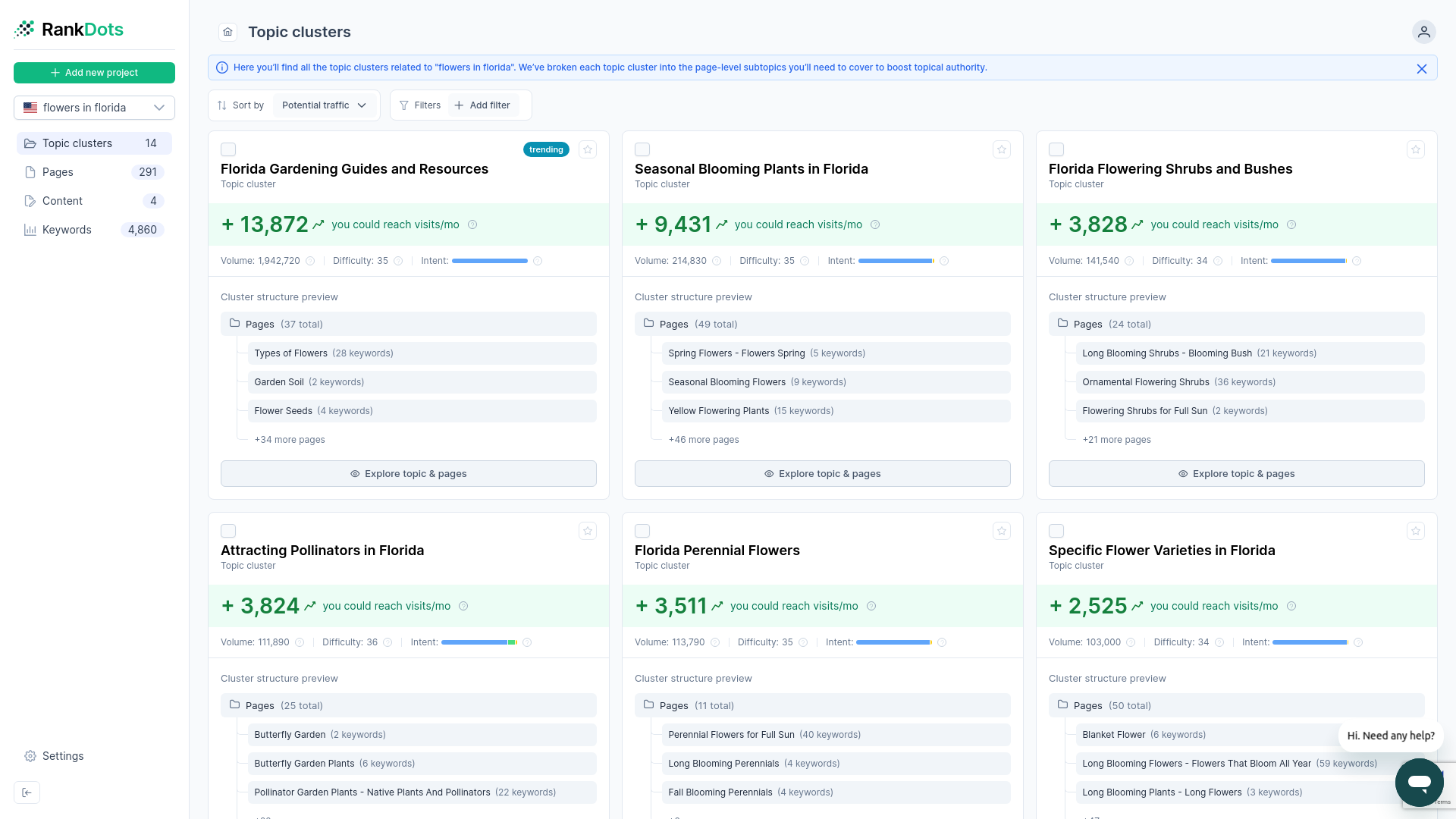
This translates to a stark operational difference. Using Keyword Insights, an SEO specialist uploads a massive list of terms, waits for the NLP model to categorize them, and downloads a cleanly tagged spreadsheet. That spreadsheet still requires a human strategist to manually determine the site structure. RankDots eliminates that translation step. It exports a ready-to-deploy site map. You bypass the manual labor of mapping rows to URLs and move directly into content execution, ensuring your new structural build aligns perfectly with what Google already rewards.
RankDots vs. Keyword Insights: Capability Matrix
| Feature / Capability | RankDots | Keyword Insights |
|---|---|---|
| Clustering Methodology | SERP-based Keyword Clustering | SERP-based Keyword Clustering |
| Site Architecture Mapping | Topic → Page → Keyword Hierarchy | Flat Cluster Groupings |
| Content Execution | AI Content Briefs based on competitor analysis | AI Content Briefs and Draft Generation |
| Strategic Opportunities | Easy Traffic Wins & Content Gap Identification | Keyword Discovery & Hub Suggestions |
| Intent & SERP Context | Search Intent Detection with SERP Feature Tracking | Search Intent Classification |
Core Features and Capabilities
Once you finalize your keyword clusters, the immediate hurdle is transferring that strategy to your writing team. Generating structured outlines for a roster of freelance writers typically devolves into a disjointed workflow. SEO managers end up copy-pasting data across multiple tabs, keyword tools, and Google Docs. Critical intent context gets lost in this manual handoff, resulting in drafts that require heavy structural editing.
Comparing the core capabilities of RankDots vs Keywordinsights requires a hard look at processing scale and downstream execution. Both platforms group terms, but their threshold for enterprise data and their final output formats vary completely.
RankDots is engineered specifically for high-volume agency environments, comfortably clustering up to 2.5 million keywords simultaneously. When onboarding a major B2B SaaS account, you can dump an entire competitor's Semrush export—or massive isolated lists pulled from your Long-Tail Keyword Finder—directly into the system. You do not have to split the data into batches or worry about the browser crashing halfway through the process. The platform also maintains a 99.99% enterprise uptime guarantee, ensuring your production schedule never stalls due to server timeouts.
The most aggressive workflow shift happens during brief generation. Moving from a clustered spreadsheet to an actionable writer instruction document is traditionally a massive bottleneck. RankDots automatically converts your finalized clusters into AI Content Briefs, driven by direct competitor analysis from the current top 10 results. Instead of handing a writer a generic list of 30 LSI keywords and crossing your fingers, you hand them a structured outline containing exact H2 headings, target word counts, and mandatory subtopics based on actual SERP requirements.
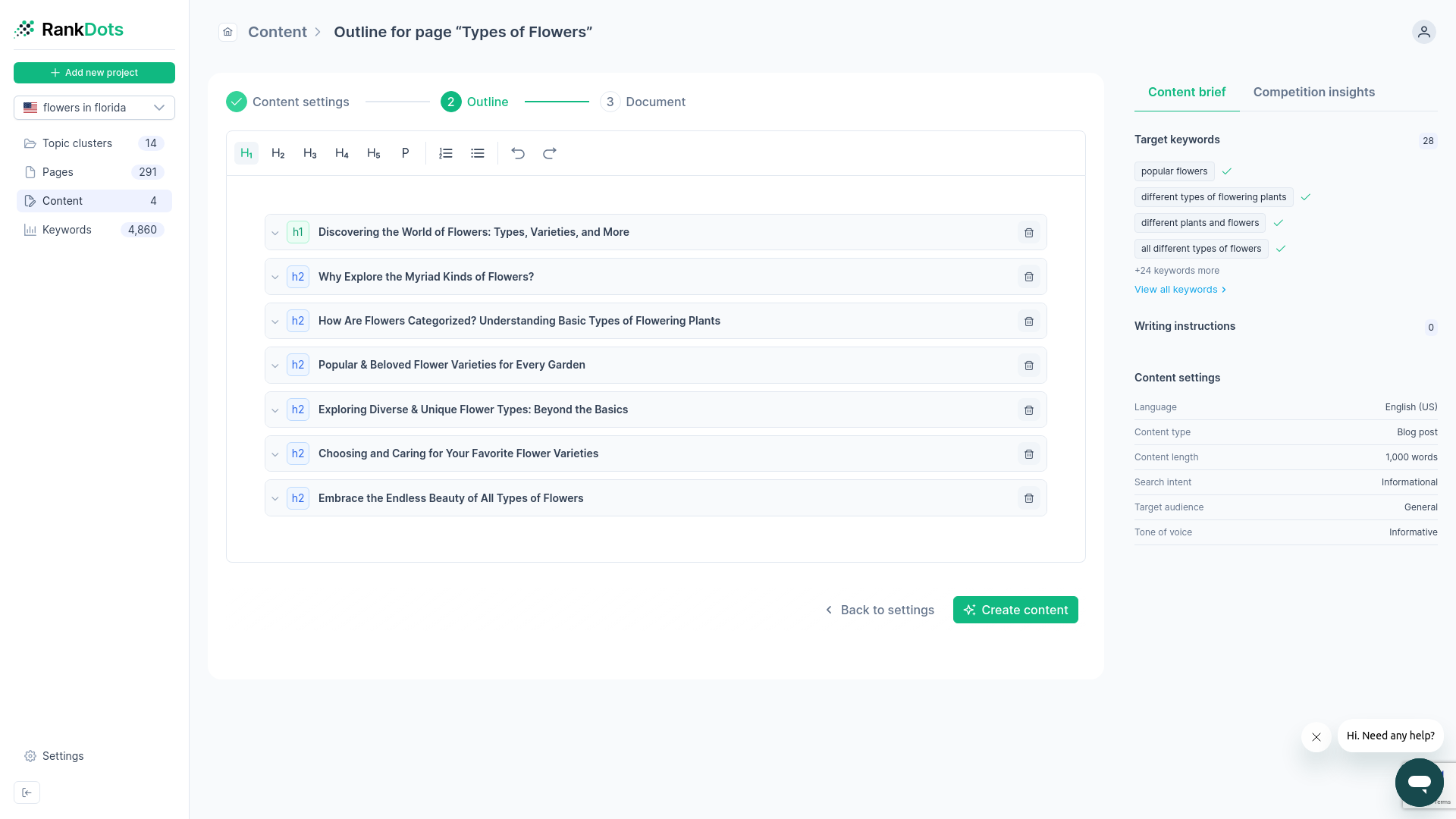
Review how these features align in a high-velocity content setting:

| Feature Capability | Standard Clustering (Keyword Insights) | RankDots |
|---|---|---|
| Data Processing Limits | Standard dataset limits | Up to 2.5 million keywords |
| Structural Output | Flat spreadsheet of grouped terms | Visual parent-child topic hierarchy |
| Writer Instructions | Exportable keyword lists | Comprehensive AI Content Briefs |
| System Reliability | Varies by server load | 99.99% enterprise uptime guarantee |
Standard NLP clustering tools drop you at the finish line of the research phase. They organize the data accurately, but you still have to build the bridge to content creation yourself. By embedding AI Content Briefs directly into the clustering workflow, RankDots removes the tedious formatting tasks that consume an SEO manager's week. You are paying for a system that actively pushes the drafting process forward, rather than just categorizing raw inputs.
Where RankDots Pulls Ahead in SEO Workflows

Topic → Page → Keyword Hierarchy
Instead of managing flat spreadsheets of thousands of terms, RankDots structures your campaigns into a strict hierarchy. Connect overarching topics directly to specific target pages and their clustered keywords to keep site architecture clean.

SERP-Based Keyword Clustering
Move beyond basic lexical matching. RankDots analyzes live search results to group keywords exactly how search engines understand them, heavily reducing your risk of keyword cannibalization.

Data-Driven AI Content Briefs
Generate actionable outlines based on real-time competitor analysis. Equip your writing team with precise structural requirements, word counts, and required subtopics rather than generic AI prompts.

Automated Search Intent Detection
Instantly classify your clustered keywords by user intent—informational, commercial, transactional, or navigational—ensuring you build the exact content format searchers expect to see.
Pros and Cons: Evaluating RankDots vs. Keyword Insights
Pros
- Maps terms into a distinct Topic → Page → Keyword Hierarchy, moving your strategy beyond isolated clusters into actionable site architecture.
- Bridges the gap between research and execution by connecting SERP-based Keyword Clustering directly to AI Content Briefs.
- Automatically identifies Content Gaps and Easy Traffic Wins without requiring manual spreadsheet pivots or external data merging.
- Tracks Search Intent Detection at the cluster level, ensuring your content type matches current SERP realities.
Cons
- Requires teams to adopt a unified content workflow rather than relying on fragmented, standalone clustering tools.
- Focuses strictly on content strategy and on-page optimization, meaning you will still need a separate tool for backlink profiling and off-page SEO.
Strategic Differences: Keyword-First vs. SERP-Based Clustering
Automated brief generation fails if the underlying keyword groups do not match Google's exact intent expectations. The technical engine powering the clustering process is the most critical distinction between these tools.
Pitching an organic software stack to a performance marketing director rarely goes smoothly. They face constant pressure to allocate budget toward immediate, measurable SEM campaigns. To win budget for advanced SEO tooling, you must prove that your organic architecture will structurally outlast and outperform rented ad placements. Accurate Keyword Difficulty Analysis and ROI forecasting rely entirely on understanding actual SERP competition, not arbitrary metric scores attached to isolated words.
The fundamental limitation of traditional NLP-only clustering is linguistic false positives. An NLP model evaluates the lexical relationship between words. It will group "enterprise CRM software" and "enterprise CRM software login" into the same cluster because they share core terminology. If your agency builds a single landing page targeting both terms, you will rank for neither. In 2026, Google strictly separates these intents. The first searcher wants to evaluate and purchase a product; the second searcher is an existing customer trying to access their dashboard.
RankDots eliminates this cannibalization risk by deploying strict SERP-based Keyword Clustering. Instead of analyzing linguistics, the algorithm queries the live Google results for every term and compares URL overlap. If Google ranks the exact same pages for "CRM software" and "CRM tools," RankDots clusters them together. Because there is zero URL overlap between software landing pages and login portals, RankDots automatically splits them into distinct intents. This agglomerative approach guarantees your agency builds pages that align precisely with current algorithmic realities.
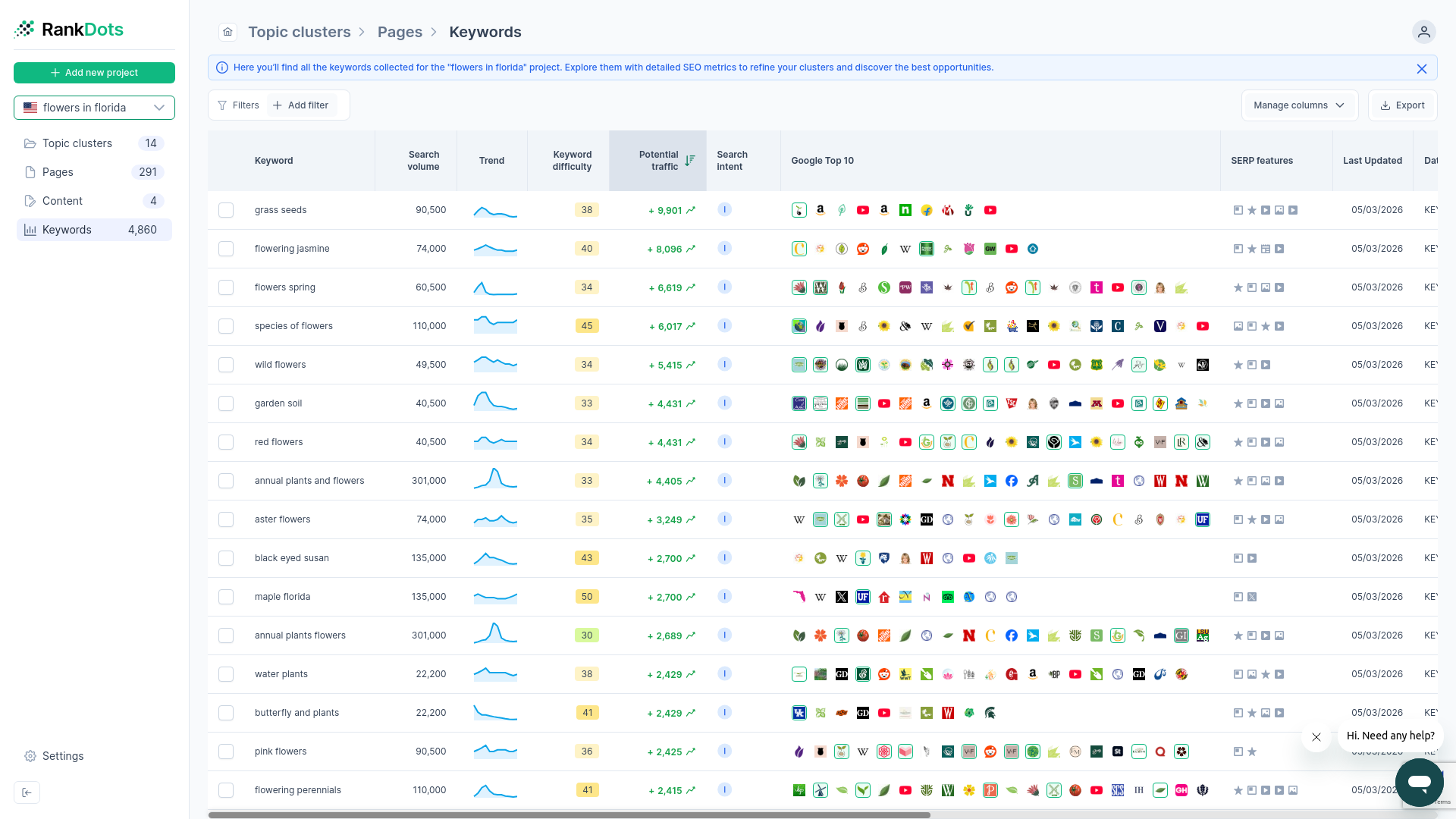
Superior architectural accuracy directly influences organic acquisition, which heavily outweighs paid channels in sustainable value. Consider the industry data: organic search accounts for 53% of all trackable website visits across sectors, according to BrightEdge's industry report. Further reinforcing the value of organic positions, Google's organic results attract 19x more clicks than paid results.
Modern, correctly targeted SEO efforts convert reliably at a 2.4% average rate, a benchmark confirmed in FirstPageSage's extensive tracking. By utilizing SERP-based clustering, you ensure your agency exclusively targets verified, distinct search intents. The workflow executes as follows:
- The system scrapes the live top 10 results for tens of thousands of keywords, instantly highlighting exactly How to find easy-to-rank keywords that competitors have misclassified.
- It cross-references URL overlap between seemingly unrelated terms.
- It groups keywords into a single page only if Google already rewards the same URLs for those queries.
- It maps the newly verified cluster into a broader hierarchical site structure.
You avoid hours of manual intent filtering and build a foundational acquisition channel that systematically outperforms paid placements over a multi-year timeline.
Pricing Details and Investment Comparison
Running advanced SERP-based overlap analysis requires massive computational power, which heavily influences how clustering platforms structure their pricing.
Both platforms utilize a credit-based model tied to keyword volume, but their subscription tiers target different agency needs. Keyword Insights provides lower-tier entry points that are highly practical for occasional, ad-hoc content audits. They charge credits primarily for basic NLP clustering and entity extraction. RankDots builds its tiers around end-to-end production pipelines. Its pricing models the processing of millions of keywords, the automatic generation of topic hierarchies, and the bulk export of AI Content Briefs.
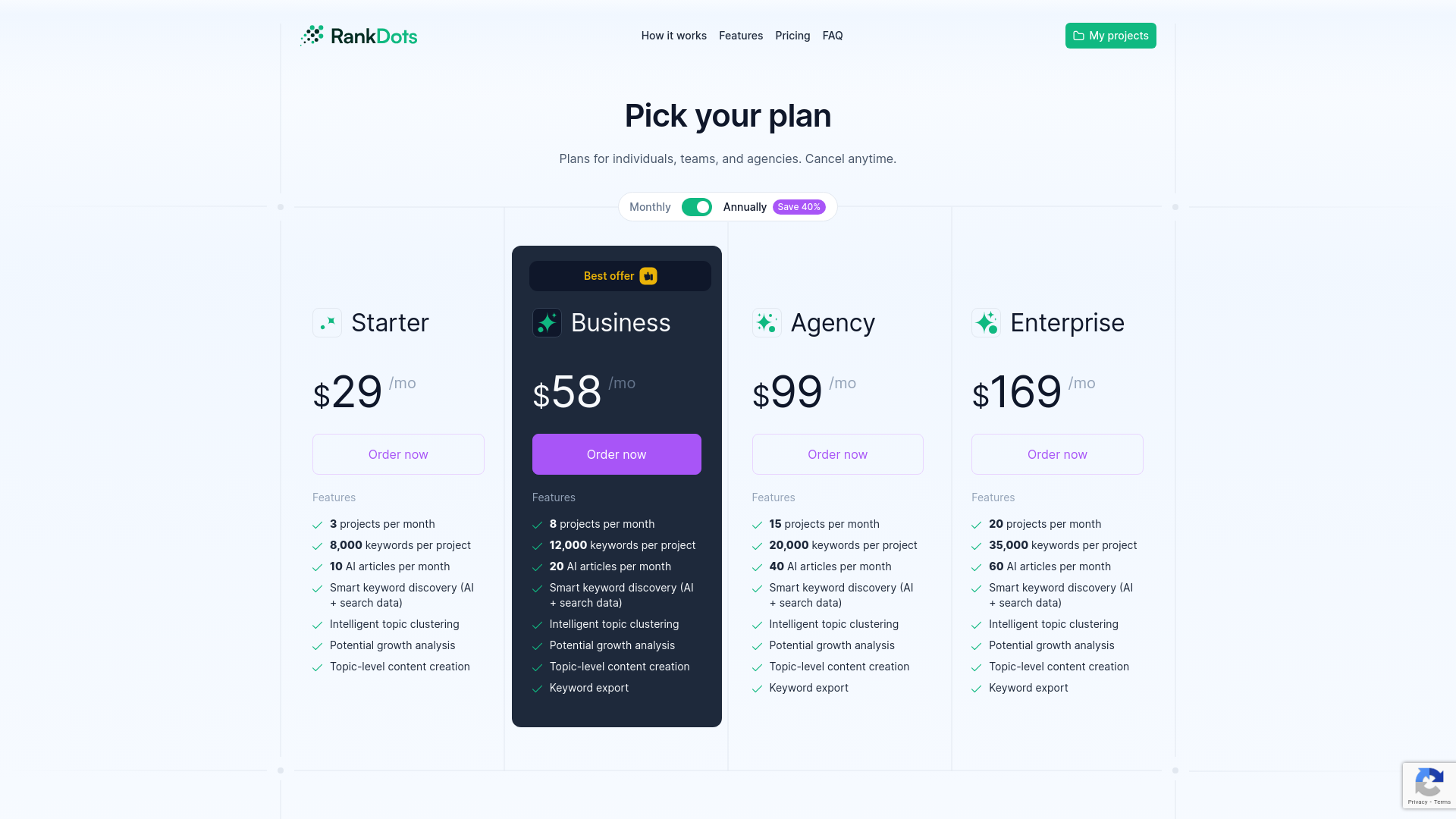
When calculating the actual cost of software for your agency, frame the subscription fee directly against your current manual labor costs.
Calculate your true ROI using this exact framework:
- Audit the weekly hours your SEO specialists spend manually deduplicating spreadsheets, cross-referencing SERPs, and formatting writer outlines in Google Docs.
- Multiply those hours by your agency's hourly billable rate.
- Subtract the monthly subscription cost of the platform.
If a mid-level SEO specialist spends 15 hours a week manually grouping terms and writing briefs, and their billable rate is $120 an hour, your agency loses $7,200 a month in operational drag. For an agency processing 100,000 keywords a month, automating the hierarchy and brief creation recovers that lost margin within the first week of deployment. The software cost is negligible compared to the recovered billable hours.
Integrations and API Access
Once you justify the financial investment, the platform must physically plug into your agency's existing tech stack. Data sitting in a silo provides zero efficiency gains.
Enterprise workflows run on interconnected data streams. Assessing RankDots vs Keywordinsights means evaluating how easily you can push finalized clustering data into a client's CMS platform or your agency's proprietary reporting dashboards.
Modern API rollouts allow your engineering team to bypass sluggish enterprise integration timelines. Instead of waiting three quarters for IT to approve a custom bridge, agile platforms prioritize deployment speed. Current deployment benchmarks show an agile platform integrates fully in 30 days, bypassing the typical 90 to 120 days associated with legacy SEO software suites.
RankDots allows you to push SERP-validated clusters straight into custom reporting pipelines, completely eliminating manual CSV uploads. Whether your team generates bulk writer instructions via Google Docs integrations or feeds structured topic models directly into a client's custom headless CMS, robust API access ensures your keyword data flows exactly where your writers and developers need it.
Customer Support and Training
The most advanced API integration still relies on human operators understanding how to manipulate the data.
Rolling out new SEO software usually triggers a sharp drop in productivity as junior staff struggle with the learning curve. However, the onboarding infrastructure dictates how quickly your team recovers. Comprehensive technical documentation, dedicated account managers, and responsive technical support drastically reduce this friction period.
Speed to value determines the success of any software adoption. Just as enterprise platforms like ZipRecruiter deliver qualified candidates to 80% of employers within the first 24 hours, a specialized SEO tool must deliver immediate, actionable clarity to your internal team upon login.
Integrating a high-capacity clustering platform immediately changes your operational ceiling. Automating the ingestion of massive keyword dumps and instantly outputting AI-assisted briefs allows your agency to double its content production volume without sacrificing intent accuracy. Review your current client load, identify the account with the most disorganized content architecture, and run a limited sample through a SERP-based clustering engine to benchmark the exact time savings.
Frequently Asked Questions
What are the best alternatives to RankDots and Keyword Insights?
Choose the Right Content Intelligence Tool for Your Agency
Stop wasting billable hours manually categorizing spreadsheet rows. Transform raw data exports into a ready-to-deploy Topic → Page → Keyword Hierarchy using our SERP-based Keyword Clustering, and scale your content production with structural accuracy.