How to find easy-to-rank keywords
How to find easy-to-rank keywords: A topics-first guide
You've just spent 10 hours writing a definitive, 2,500-word industry guide. You hit publish, confident this comprehensive piece will pull in qualified leads. Three months later, that expensive asset is sitting motionless on Page 6 of Google. You targeted a highly competitive core term instead of building a semantic foundation first. Learning how to find easy-to-rank keywords requires shifting away from isolated search volumes. You need a topics-first approach integrated into your broader keyword research strategy. By applying Keywords Clustering and mapping out competitor blind spots, you can identify low-competition, high-potential long-tail variations. This allows newer or lower-authority websites to secure foundational organic traffic quickly.
Every minute spent crafting content that never reaches Page 1 burns capital. In 2026, you are competing against massive industry giants with unbeatable domain authority. Quality, authoritative content drives search engine rankings, but throwing a long-form article at a brick wall of established competitors yields nothing. You need a foothold. Using a Long-Tail Keyword Finder to target high search volume, low competition phrases lets new websites bypass that wall entirely.
This guide outlines a 5-step framework to uncover low-competition keyword clusters. These clusters establish topical authority and drive compounding organic traffic over time. We are abandoning the outdated method of blindly trusting third-party difficulty scores. Instead, you will spot actual SERP weak spots and adopt an algorithmic SERP-based Keyword Clustering approach. Content creators should aim for articles of 1,500 to 3,000 words to cover topics comprehensively—but only after validating that the chosen topic cluster has an open runway for a new domain.
Real value in low-competition variations
Most DIY content marketers hear the phrase "low-competition" and immediately assume "low-value." They picture zero-volume phrases that nobody actually searches for. That is a dangerous misconception. Easy-to-rank keywords are high-intent, long-tail phrases where current search results completely lack authoritative, satisfying answers.
Think of these keywords as your vital building blocks when managing a newer site. Targeting high search volume, low competition long-tail keywords allows new websites without high domain authority to quickly build a foundation and rank. It mimics establishing a highly profitable local storefront in a thriving neighborhood before attempting to fund a mega-mall downtown.
Are low-competition keywords good for SEO strategy? Yes. They are the single most reliable entry point for sites without massive backlink profiles. Targeting a highly detailed query naturally captures users further down the conversion funnel. A broad search for "small business accounting software" is dominated by SaaS giants. A specific search for "how to reconcile Shopify payouts in Xero for handmade businesses" is a weak spot waiting for your direct expertise.
Should you avoid high-competition keywords completely? Absolutely not. High-competition keywords remain your long-term objective. They sit at the apex of your Topic → Page → Keyword Hierarchy. However, you cannot rank for that apex without first establishing topical authority through supporting, low-competition variations. Every time you successfully rank for a highly specific long-tail question, search algorithms register your site as slightly more authoritative in that broader category.
Consider a specialized fitness coaching business. Writing an article targeting "weight loss tips" puts you in direct competition with massive health portals like WebMD or Healthline. That is an unwinnable battle for a newer domain. Targeting "strength training routine for 40-year-old women with knee pain" gives you a clear, unobstructed runway. The search volume is smaller, but the conversion rate will be exponentially higher because the user intent is hyper-specific. These specific queries pay the bills and build relevance while your overall domain authority matures.
The topics-first approach: Moving beyond search volume
For years, keyword research followed a rigid, flawed template. You exported a list from a tool, sorted by the lowest difficulty score, and wrote one isolated article for every single phrase. This produced dozens of thin, overlapping pages that directly cannibalized each other's organic traffic.
We must stop treating related long-tail phrases as separate articles. Individual webpages naturally rank for dozens of keyphrases simultaneously because Google operates as a semantic search engine. The algorithm parses context, entities, and search intent. If you write a comprehensive guide on "cold brew coffee ratios," that exact same page will naturally rank for "how much coffee for cold brew" and "cold brew water ratio."
There is a strict limit to this semantic umbrella. A single webpage rarely achieves rankings for multiple unrelated keyword phrases. Trying to rank a single page for "cold brew ratios" and "best commercial espresso machines" dilutes your topical relevance completely. You must group terms that share the exact same user intent.
Manual research breaks down at this stage. Writers waste hours creating separate articles for keywords with identical search intent, dividing their own link equity and cannibalizing traffic. To prevent this, you need to analyze the actual search engine results pages (SERPs) rather than guessing based on spreadsheet data.
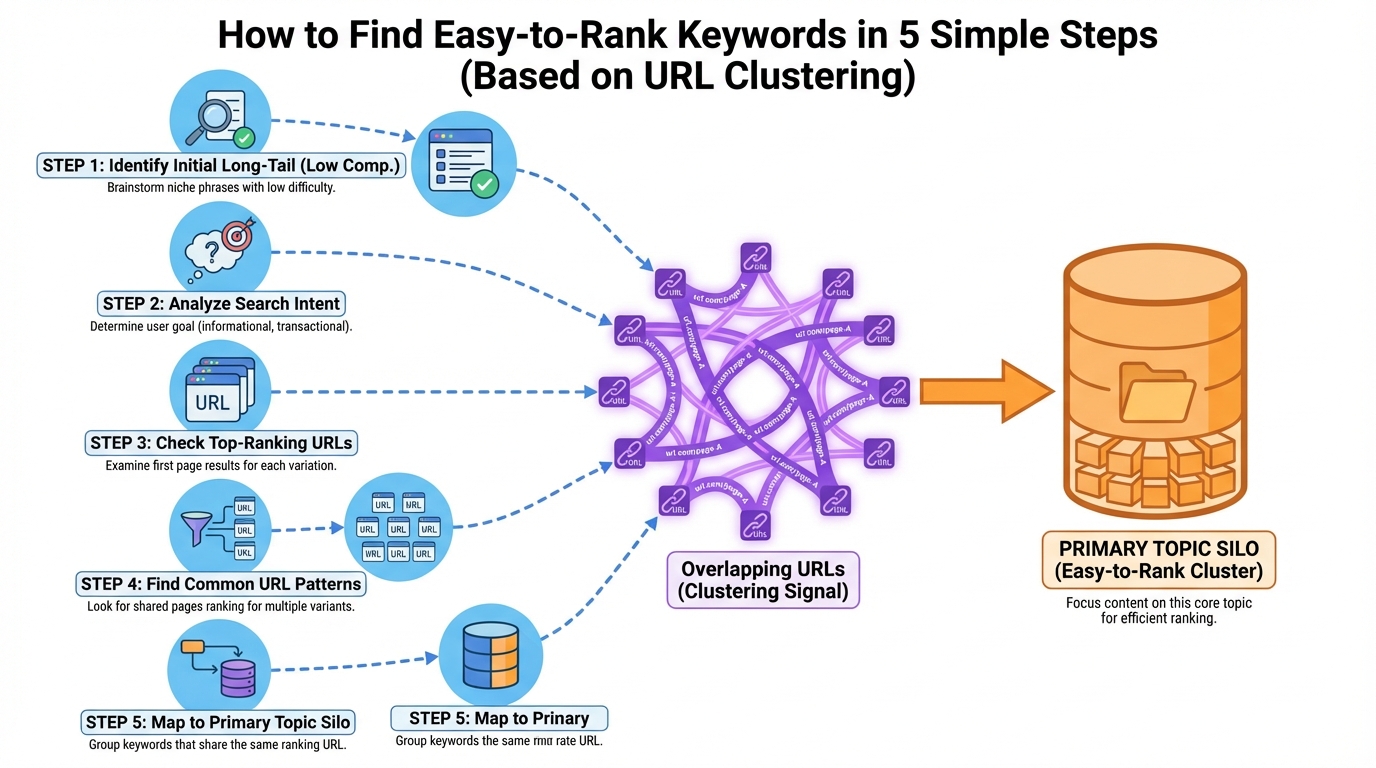
By utilizing SERP-based Keyword Clustering, you automatically group related terms that Google already ranks together. This allows you to target entire topics with a single authoritative page. If the search engine shows the exact same five URLs ranking for both "freelance graphic design contracts" and "how to write a design retainer," the Search Intent Detection algorithm is explicitly telling you those are the same topic.

Moving beyond isolated search volume means calculating the aggregate potential of a cluster. A primary keyword might show just 150 searches per month. When clustered with 25 semantic variations sharing the same intent, the true traffic potential often exceeds 2,000 monthly visits. A topics-first approach stops you from chasing individual metrics. You start building comprehensive, authoritative pages that satisfy the entire spectrum of a user's question. Instead of managing 50 disconnected posts, you build one definitive resource. This protects your site from algorithmic shifts and establishes deep topical authority that competitors cannot easily replicate.
5 Phases of a Topics-First Keyword Strategy
-
Brainstorm Seed Topics
Start by identifying the core themes your target audience actually cares about. Rather than throwing random queries into a tool, map out broad, high-level topics directly tied to your product or service offerings.
-
Expand and Uncover Easy Traffic Wins
Use keyword research to generate hundreds of long-tail variations from your seed topics. Filter the data to isolate Easy Traffic Wins—highly specific queries where competitors have ignored the nuance or failed to provide comprehensive answers.
-
Analyze Search Intent and SERP Competition
Never trust a single metric for difficulty. Review the actual search engine results pages (SERPs) to detect Search Intent. Look for structural weaknesses on page one, such as forum threads, thin content, or outdated posts that signal an opportunity to rank quickly.
-
Cluster Keywords into a Topic Hierarchy
Stop creating one page per keyword. Use SERP-based Keyword Clustering to group related terms that Google already ranks together. Organize these into a clear Topic → Page → Keyword Hierarchy so your content architecture supports your rankings rather than cannibalizing them.
-
Generate Briefs and Execute
Translate your data into action. Build structured AI Content Briefs that map out the exact headings, user questions, and semantic terms required to satisfy intent and outperform the existing competitor content.
Step-by-step guide to finding keyword opportunities via SERP clustering
Let's translate this topics-first theory into a repeatable daily workflow. We are going to filter out the noise and zero in on the exact queries where your smaller site holds an unfair advantage.
Picture this scenario. You decide to target easier keywords, run a broad search for your niche, and export a spreadsheet of 8,000 keyword ideas. Analysis paralysis hits immediately. You are staring at raw data without a tactical filtering mechanism to identify which of those thousands of keywords actually feature weak spots in the search results.
You want to use a dedicated Keyword Discovery Tool to find these weak spots, but typical enterprise SEO tools cost over $100 per month. Anxiety over business expenses is real when bootstrapping a content operation. Fortunately, you don't need a massive enterprise budget to execute this strategy. LowFruits is an affordable keyword research tool with plans starting at $21/month. It works perfectly for extracting accurate SERP difficulty data without breaking the bank.
Follow this 5-step workflow to uncover and cluster easy-to-rank keywords:
Step 1: Brainstorm broad seed terms Begin with the core categories of your business. If you sell accounting templates, your seed terms aren't just "accounting." They are "chart of accounts," "expense reconciliation," and "cash flow forecasting." You want mid-level concepts that can spawn hundreds of specific questions.
Step 2: Generate aggressive long-tail variations Plug your seed terms into your chosen tool and extract every possible "how to," "vs," and "best" variation. This generates that massive list of 8,000 terms. Do not manually sift through this list yet.
Step 3: Filter mercilessly by maximum SERP difficulty We need to cut the fat aggressively. Apply a strict maximum difficulty threshold to your raw data. In one recent 2026 campaign, applying rigorous Keyword Difficulty Analysis to filter a list by a SERP Difficulty (SD) max of 1 reduced an 8,000-keyword list down to just 409 keywords. An overwhelming dataset suddenly becomes an actionable hit list.
Step 4: Identify actual weak spots in the SERP A low difficulty score from a third-party tool acts as a good proxy, but it isn't reality. Reality is what currently ranks on Page 1 of Google. Look for specific vulnerabilities. User-generated content like Quora or Reddit, sites with a Domain Authority under 20, content older than three years, or pages where the exact search intent is missing from the title tag are all prime targets.
Manually filtering your remaining terms to find these vulnerabilities takes hours of tedious spreadsheet work. The Easy Traffic Wins feature becomes essential here. It instantly scans your keyword list and flags terms where low-authority domains currently rank on page one. In our previous data set, the SERP extraction tool identified 205 keywords with weak spots out of the filtered list of 409.
Why do these weak spots exist? Large media publications write broad pillar pages and abandon them. Google ranks them based on domain authority, not content quality. When you spot an article from 2018 ranking for a 2026 software question (often verifiable through a wayback machine alternative), that is a prime weak spot. Spotting a forum thread with three replies from 2015 is even better. The algorithm hates ranking unresolved forum threads, but it has no choice if no one else has published a comprehensive answer.
Step 5: Cluster by overlap and prioritize You have your 205 vulnerable keywords. Now, group them. If you search for "how to categorize software subscriptions" and "what category is SaaS expenses," and see the same three forums ranking on Page 1 for both, those keywords belong in the exact same cluster.
Not all easy-to-rank keywords carry equal weight. Prioritize based on business value, not just low competition. A vulnerable cluster around "history of accounting" might be easy to rank, but it drives zero revenue. A cluster around "QuickBooks vs Xero for freelance designers" carries massive commercial intent. Build a scoring rubric. Award points for high commercial intent, personal expertise, and the severity of the SERP weakness.
You started with an impenetrable block of 8,000 terms. By applying strict difficulty limits, identifying actual SERP vulnerabilities, and clustering semantic overlaps, you generate a targeted, multi-month editorial calendar. You know exactly what to write, how to structure the clusters using AI Content Briefs, and precisely who you are unseating on Page 1.
Finding content gaps through competitor data
Once you master SERP clustering, examine the sites already winning in your space. Competitor Content Analysis establishes a baseline. It shows you exactly what topics Google expects a site in your niche to cover. Trying to measure if your new keyword strategy works by strictly relying on third-party estimates, however, brings massive frustration.
Imagine this scenario. You want to find your baseline rankings to measure progress. You check one platform and it says you rank for 17,000 phrases. You check another, and it says 6,000. Third-party tools output conflicting visibility data, making it impossible to know your actual starting point.
This massive data discrepancy is completely normal. For instance, one leading platform found 17,200 ranking phrases for Orbit Media's test website, while SpyFu found 44,218 ranking phrases for the exact same domain. A separate tool audit widened the gap further; a third audit found 6,115 ranking phrases for the site. Moz conducted research comparing the traffic prediction accuracy of competitor analysis tools like SimilarWeb. The conclusion is absolute: third-party estimates work well for broad competitive research, but they fail entirely at establishing your absolute baseline.
For your own site's ground truth, using Google Search Console to track keyword rankings provides the essential baseline metrics required to measure SEO progress. Rely on your first-party data for your baseline. Use competitor data strictly for strategic reconnaissance.
Knowing what a competitor ranks for doesn't automatically reveal where they are vulnerable or what critical sub-topics they missed. You can pull their top-performing URLs, but manual analysis rarely uncovers the specific long-tail questions they ignored in the body of their content.
Content Gap Identification solves this directly. It analyzes top-ranking pages to reveal exactly which questions and semantic sub-topics competitors failed to answer, handing you the blueprint to outrank them. If a rival writes a 2,000-word guide on "setting up email automation" but completely ignores the nuances of "bypassing spam filters for welcome sequences," you just found a profitable gap.
Pivot your strategy from simply observing competitor traffic to aggressively targeting these neglected sub-topics. Do not copy their article. Write the comprehensive cluster they forgot to build. Extract their top URLs, run them through a gap analysis, and build clusters strictly out of the high-intent queries they left on the table. This strategy siphons their potential traffic without forcing you into a direct fight over their strongest anchor terms.
Post-discovery content optimization and strategy
Finding the right keywords only covers half the workflow. How you integrate them into your site dictates your actual success. Many DIY marketers discover a great new keyword and immediately try to force it into their most successful existing articles.
Say you notice one of your older blog posts ranking well. You decide to edit it to target a highly-searched, completely different new keyword you just uncovered. You aggressively rewrite the title and headers. Suddenly, your traffic drops. Forcing an unrelated keyword into the metadata and content de-optimizes the page for the semantic terms it already ranks for. Optimizing an existing page for a new keyphrase can de-optimize it and harm its rankings for current ranking phrases.
Instead of hijacking successful posts, focus on refreshing pages that actively lose traffic. Regularly updating older content prevents content decay and maintains relevance for search engines. To combat content decay, update a 2-year-old post titled '10 Tips for First-Time Home Buyers' to reflect current 2026 mortgage trends and new FHA loan limits. Keep the core semantic relevance intact while expanding the cluster with fresh, low-competition sub-topics you recently discovered.
When making these targeted updates, stop keyword stuffing. Limit keyword phrases in metadata to 3-7 phrases consisting of 1-4 words. Choose a tight cluster of highly relevant terms and weave them logically into your headers and introductory paragraphs.
Once you make these updates, the waiting period begins. Armed with a manageable list of low-competition keywords, you update a decaying post to match the new intent and check your analytics daily. Impatient anticipation happens to everyone, but you must respect the timeline. How long does it take to improve keyword rankings? Generally, it takes 4-6 months after implementing SEO strategies to see an increase in search engine impressions. SEO runs as an algorithmic marathon, not a sprint. Trust the clustering process, let search engines process your semantic updates, and focus your energy strictly on writing the next topic cluster.
Frequently Asked Questions
What are the best tools to find high search volume, low-competition keywords?
How often should I monitor my keyword rankings?
Do low search volume keywords actually drive meaningful traffic?
Should I update old content or write new articles to target easy keywords?
The path forward with easy-to-rank keywords
Mastering how to find easy-to-rank keywords transforms your SEO approach from a frustrating gamble into a predictable growth framework. Isolated search volumes are vanity metrics. True organic success comes from identifying actual SERP gaps, clustering semantic overlaps, and building comprehensive topic hierarchies that directly answer the exact intent of the user.
You don't need to chase massive link-building campaigns to secure these early victories. Content creation consistently proves more valuable than off-page SEO for long-term growth and organic scalability. When you systematically target the weak spots left behind by industry giants—outdated articles, unresolved forum threads, and thin competitor pages—you build an undeniable foundation of topical relevance.
Stop staring at overwhelming spreadsheets of 8,000 disconnected terms. Implement the 5-step clustering workflow. Identify the specific gaps in your competitors' armor, and focus on delivering the most satisfying answer on the internet for those highly specific queries. Track your progress with SERP Feature Tracking to monitor your newly won snippets. Build the cluster, answer the intent directly, and the organic traffic will follow.
Start Uncovering Keyword Opportunities
Stop drowning in spreadsheets of disconnected search terms. Apply a topics-first methodology using our SERP-based Keyword Clustering and Easy Traffic Wins to instantly transform raw keyword lists into a structured, executable content plan.