Answer engine optimization
Answer engine optimization: Surviving the AI search disruption
You pull up the Q3 analytics dashboard, bracing yourself as the need for answer engine optimization becomes undeniable: top-of-funnel organic traffic is sliding downward week over week. Your technical site health is flawless, and your rank tracker shows stable positions. Yet, the clicks simply aren't materializing. You know exactly what you have to tell the VP of Marketing this afternoon: generative interfaces are intercepting your users directly on the SERP before they ever reach the site.
To capture traffic from ChatGPT, Perplexity, and Google's AI Overviews, you must adapt your content through answer engine optimization (AEO) so these artificial intelligence models can easily understand, retrieve, and cite your assets. It prioritizes direct answers, semantic relevance, and strong topical authority over traditional keyword density.
By 2026, traditional search engine volume will drop 25%, with search marketing losing massive market share to AI chatbots and virtual agents, per Gartner's latest market analysis. The financial impact is already severe, as organic traffic to publishers had decreased by as much as 55% due to generative AI search. This isn't an abstract future threat. Data shows that 13.14% of all Google searches (and 13.1% of U.S. desktop queries) trigger these zero-click summaries natively on the results page (Semrush, 2026).
You cannot fight the interface shift, but you can adapt your content architecture to capitalize on it. We will explore a 6-part framework for building owned, semantic topic clusters that naturally earn citations in AI Overviews and chatbots while protecting your traditional SEO traffic.
What is answer engine optimization (AEO)?
Transitioning to answer engine optimization requires fundamentally changing how you analyze search behavior with your keyword search intent tool. Traditional SEO rewards domains that match query strings with high-density keywords and authoritative backlink profiles. LLMs process information entirely differently. They rely on Retrieval-Augmented Generation (RAG) to scan verified data sources, parse relationships between entities, and synthesize a direct answer.
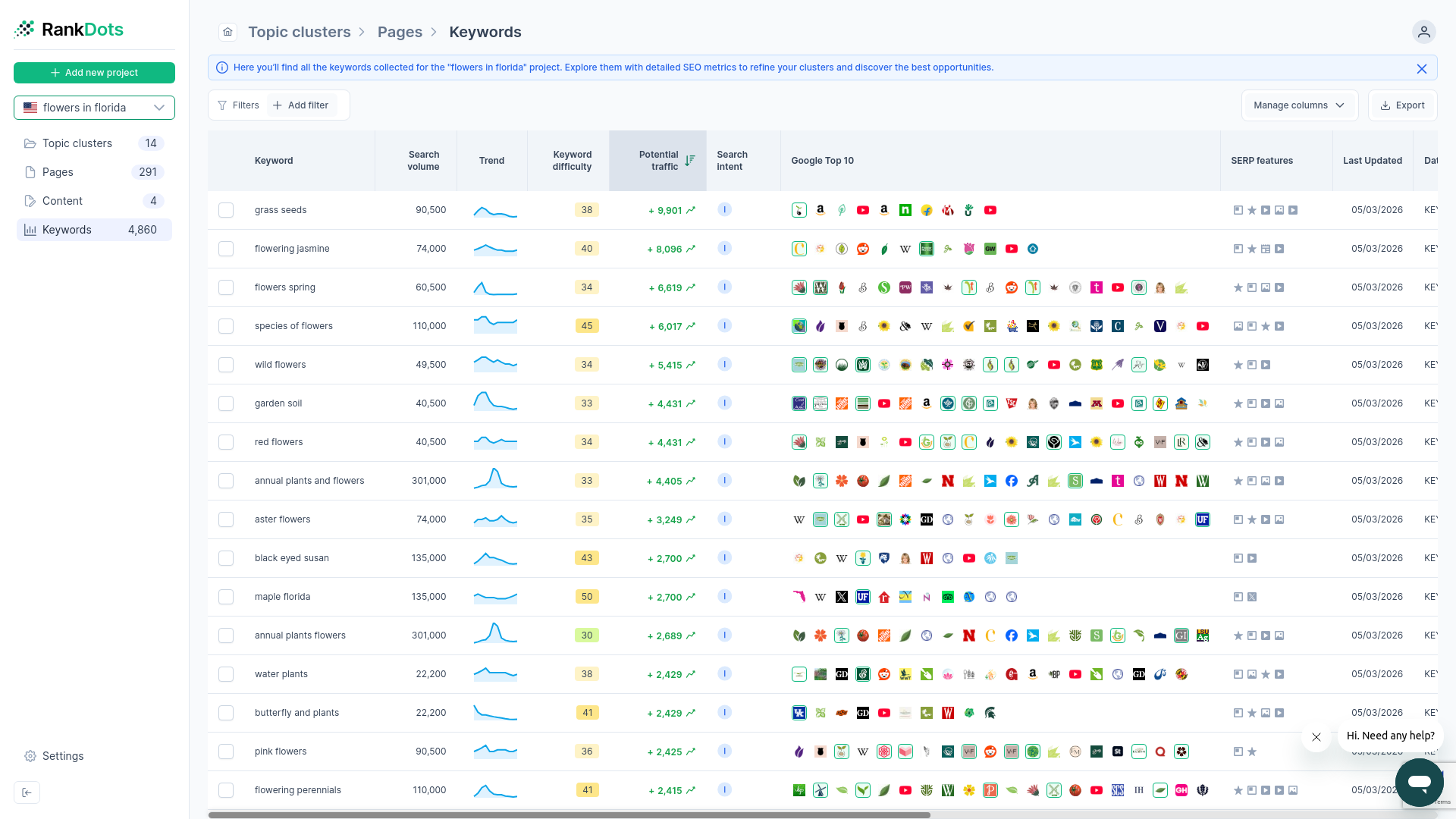
An effective AEO strategy should focus on answering specific user questions rather than solely targeting high-volume keywords. When a user asks Copilot or ChatGPT a highly specific, multi-layered question, the model does not look for a keyword match. It looks for a structured, semantically rich entity network that directly resolves the prompt. You are no longer optimizing for a crawler categorizing a document; you are optimizing for a reasoning engine attempting to extract a factual premise.
Early adopters are already seeing measurable returns from this architectural shift. Structuring data specifically for RAG extraction creates deep operational efficiencies, yielding a 68% reduction in production time for SEO content, a finding confirmed in a recent Sprout Social case study.
More importantly, the traffic you capture from these interfaces converts at a higher rate. Users who click through a citation link in Perplexity or a Google AI Overview have already consumed the informational summary; their click indicates transactional or deep-research intent. The average AI search visitor is 4.4x more valuable than the traditional organic search visitor. By aligning your content with how machines retrieve facts, you capture the most qualified bottom-of-funnel prospects on the web.
Avoiding the 'rented land' trap: Building sustainable authority
The executive meeting goes exactly as you feared. Your VP of Marketing points to the rising prevalence of zero-click queries and asks the inevitable question: why should the company continue funding the blog if LLMs are just going to scrape the answers and steal the traffic?
This skepticism is valid. The value proposition of zero-click AI answers is fundamentally flawed for marketers because visibility doesn't automatically translate to traffic. If you optimize exclusively to feed third-party chatbots—acting as a ghostwriter for a platform you don't control—you are building your business on rented land. It is the exact same trap brands fell into during the early days of Facebook page optimization.
However, abandoning content creation hands your competitors an unassailable advantage. The counter-argument is that owning deep, authoritative topical clusters forces AI engines to cite you. Citations in AI-generated answers lead to real traffic and conversions, provided the content is structured to require a click for the full context or proprietary data.
To navigate this tension, use a structured decision framework for your 2026 content budget:
The Traffic vs. Citation Decision Framework
For highly transactional queries (e.g., "buy enterprise CRM"), optimize heavily for traditional organic and paid search. AI engines typically pass these intents directly to shopping feeds or traditional blue links.
When addressing simple factual lookups (e.g., "CRM definition"), concede the zero-click answer. Do not waste budget writing 2,000 words on a topic an LLM can resolve in one sentence.
For queries requiring expert synthesis (e.g., "Salesforce vs HubSpot for SaaS startups under 50 employees"), deploy full answer engine optimization. Build deep semantic clusters that provide proprietary data, forcing the LLM to cite your domain as the primary source of truth.
Owning the underlying semantic authority protects your domain regardless of which interface "rents" the answer today.
Why semantic topic clusters outperform keyword targeting in LLMs
You open your content planning tool to map the editorial calendar for the upcoming quarter and hit a familiar wall. The high-volume head terms your traditional keyword discovery tool recommends are hyper-competitive and frustratingly vague. Worse, they don't reflect reality. Users no longer type "b2b accounting software" into search bars; they prompt chatbots with "what is the best accounting software for a 50-person agency using Stripe and Gusto?"
Traditional tools fail because they aggregate search volume around fragmented exact matches. In reality, more than half of all queries use only one or two words, per MarketingProfs. But LLMs don't parse those broad terms in isolation—they expand them based on historical context and conversational depth. At the same time, 45 percent of the SERP is content classified as Know intent (MarketMuse). To capture that intent, you must demonstrate comprehensive expertise, which requires deep semantic relationship building.
You can use RankDots' SERP-based keywords clustering feature to bridge this gap. Instead of chasing isolated terms, this feature groups thousands of long-tail queries based on actual search results overlap, natively building the semantic relationships AI models crave. If you struggle to identify these variations manually, using a dedicated long-tail keyword finder can streamline the initial discovery phase.
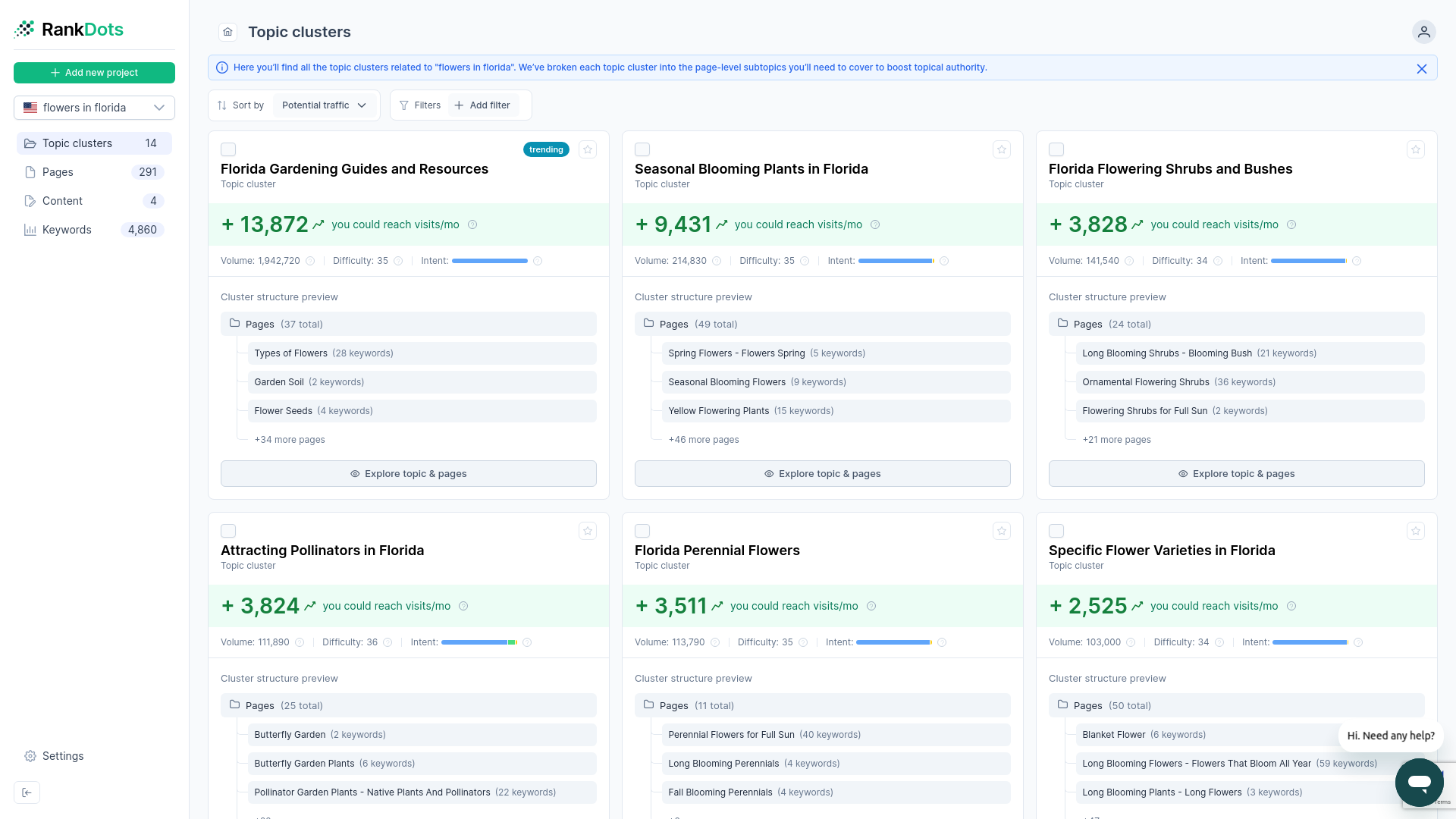
When you cluster topics semantically, you align perfectly with the mechanics of answer engine optimization. Look at the difference in data architecture:
| Feature | Single-Keyword Optimization | Semantic Topic Clustering (AEO) |
|---|---|---|
| Core Focus | Keyword density and exact match usage | Entity relationships and sub-topic coverage |
| Content Structure | Flat pages targeting distinct variations | Hub-and-spoke models with internal linking |
| LLM Retrieval | Low probability (lacks broad context) | High probability (proves comprehensive expertise) |
| User Intent | Captures one specific phrasing | Captures hundreds of conversational variations |
LLMs assign authority to domains that thoroughly cover a central entity and all its logical sub-entities. By abandoning the keyword-by-keyword approach and adopting SERP-based clusters, you construct a web of knowledge that RAG systems inherently trust and prioritize for citation.
Structuring content for answer engines (the topic-page-keyword hierarchy)
You have a massive "Ultimate Guide" sitting on your domain that used to drive thousands of visits a month. The content is expertly written, factually accurate, and comprehensive. Yet, when you ask an AI engine a question directly addressed in the piece, it cites a competitor's much thinner article. The problem isn't your writing; it's your architecture. Your guide is a flat wall of text, lacking the structural markers that AI models use to parse and extract facts.
AI models do not "read" content; they parse structured data maps. The exact architectural blueprint required to satisfy these systems is the Topic-Page-Keyword hierarchy. The E-E-A-T framework (Experience, Expertise, Authoritativeness, Trustworthiness) is essential for SEO, AEO, and GEO, but E-E-A-T only registers if the machine can logically crawl your expertise.
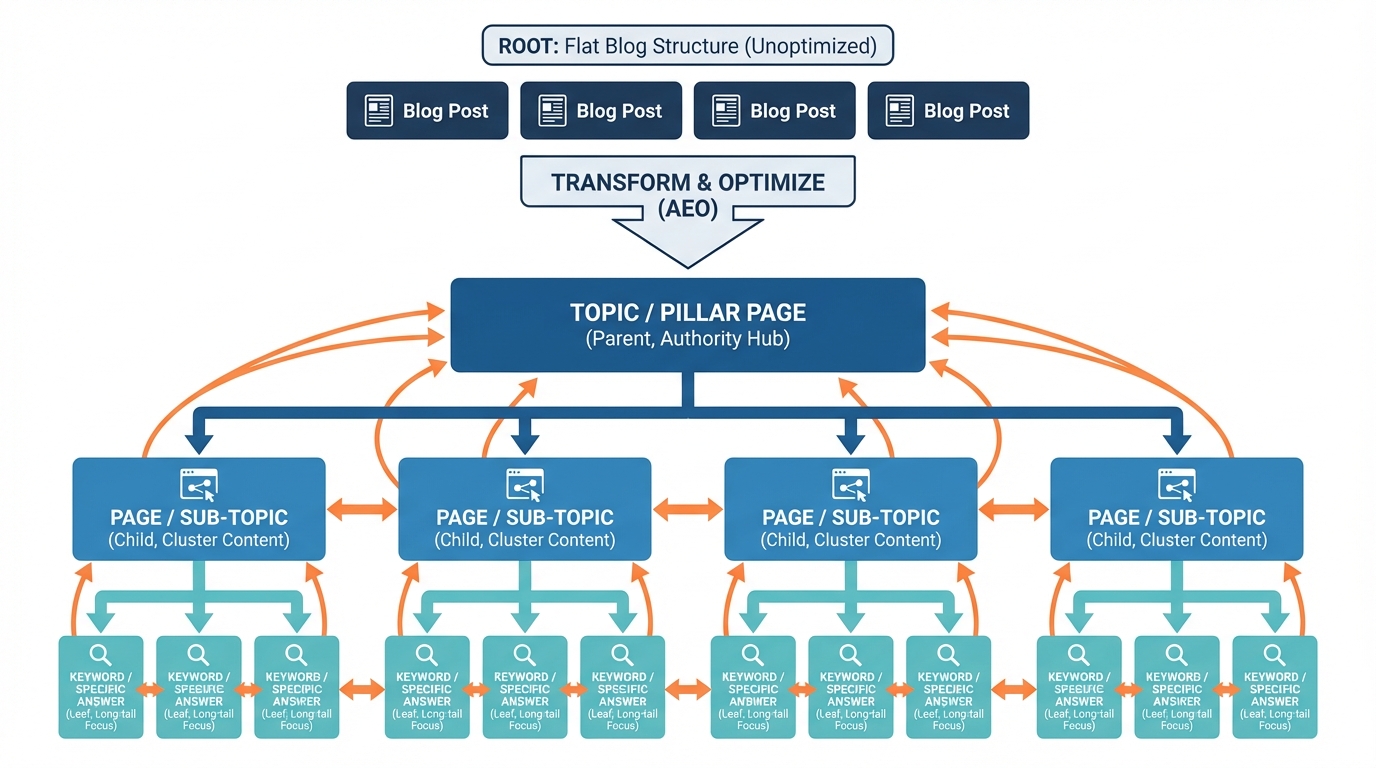
You can deploy RankDots' Topic → Page → Keyword Hierarchy feature to organize your broad topics down to specific intents, creating a structured data map for LLMs. Once the architecture is in place, you must retrofit your legacy guides.
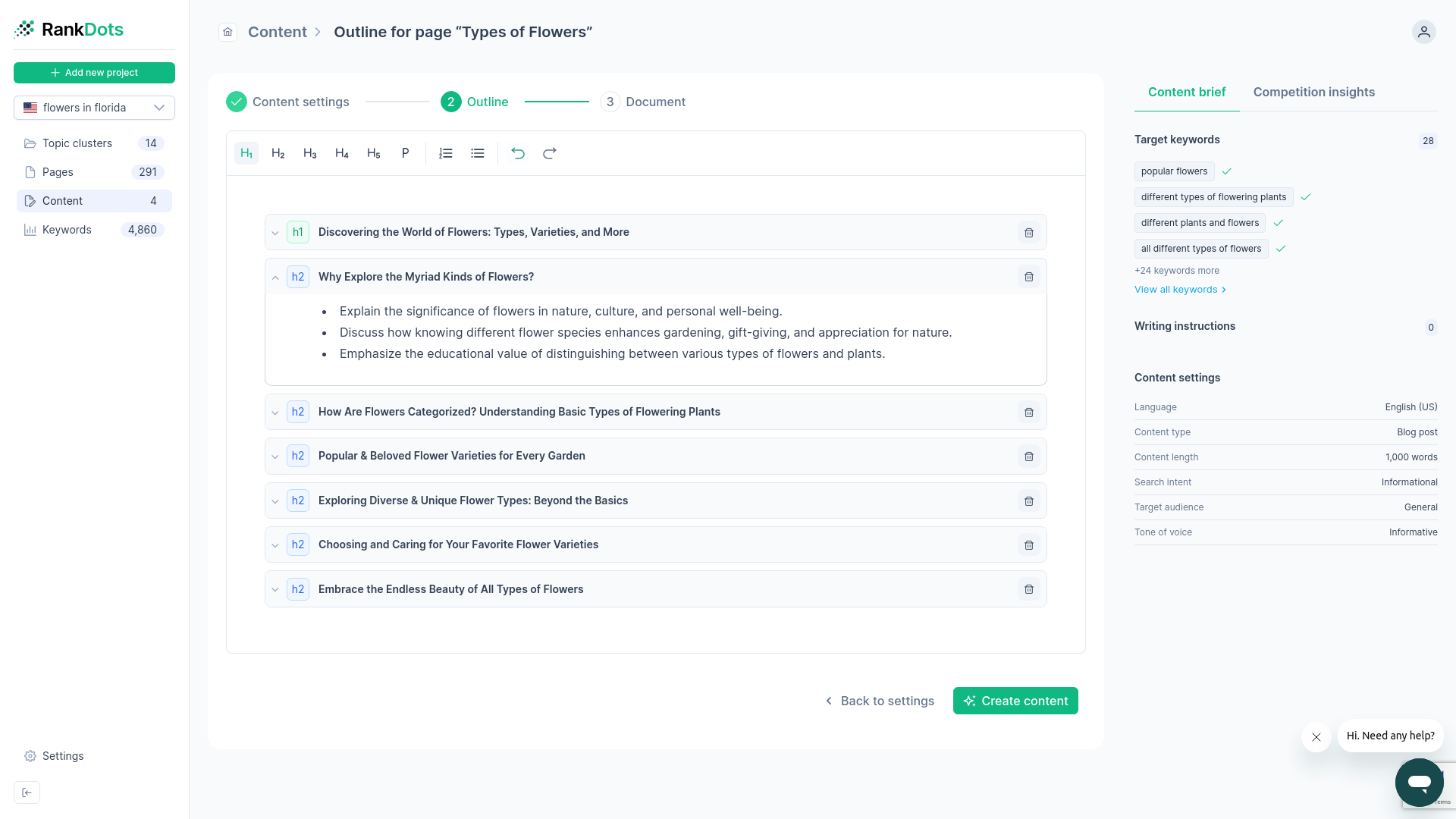
Follow this step-by-step workflow to structure your content for AI retrieval:
Start by auditing the document hierarchy. Break the monolithic "Ultimate Guide" into a central pillar page with distinct H2s and H3s that map to specific conversational questions.
Next, front-load direct answers. Immediately beneath every H2 question, provide a concise, 40-50 word definitive answer before expanding into the nuanced details. LLMs prioritize clear, easily extractable summaries.
Then, inject primary data and expert quotes. Do not just rehash the SERP. Including citations, quotations from relevant sources, and statistics can significantly boost source visibility by over 40% according to a 2025 Stanford NLP study.
After that, deploy semantic HTML formatting. Convert dense paragraphs into markdown tables, bulleted lists, and numbered workflows. Applying proper HTML SEO tags ensures RAG systems can easily parse tabular data for quick comparative analysis.
Finally, implement FAQ schema. Wrap your structured questions and answers in valid JSON-LD schema markup to explicitly hand the relationships to the crawler.
When you rebuild your content to match this hierarchy, you transition from hoping an AI reads your post to explicitly handing it the exact formatted answer it needs for its output.
Finding content gaps and maximizing information gain
You decide to run a comprehensive content audit to figure out why your brand is practically invisible in generative chatbot outputs. You test dozens of industry queries, and the result is always the same: the AI cites recently published, highly specific articles from newer competitors, completely ignoring your historically dominant cornerstone pages.
The culprit is a combination of recency bias and a lack of information gain. AI models heavily favor fresh data. In fact, 95% of ChatGPT citations come from content published or updated within the last 10 months, per a recent AirOps study. If your cornerstone content hasn't been touched in a year, it is functionally invisible to an answer engine.
Beyond recency, LLMs do not need another generic summary of a topic. They seek "information gain"—new data points, unique expert perspectives, or unaddressed sub-topics that add net-new value to the machine's training corpus. Traditional content gap analysis focuses on finding high-volume keywords your competitors rank for. In answer engine optimization, you must reframe gap analysis to identify missing informational entities and highly specific conversational questions.
You can use RankDots' Content Gap Identification feature as an advanced keyword gap finder to locate the hyper-specific questions your competitors missed. Once you identify these unaddressed entities, follow this historical optimization process:
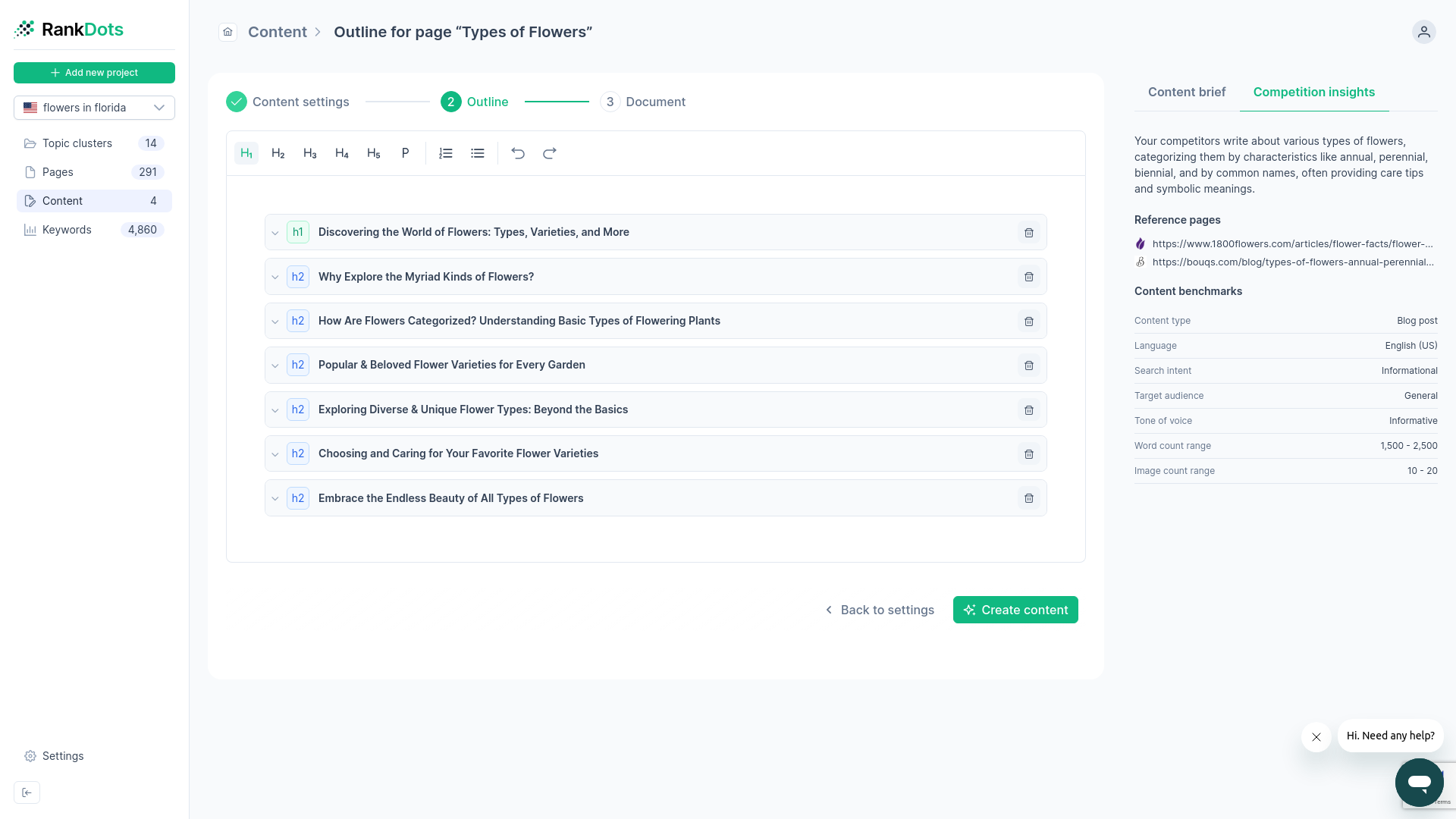
Begin by identifying decaying cornerstone pages. Filter your analytics for high-authority pages that have lost traffic over the past 12 months and haven't been updated recently.
Next, extract AI-generated entity gaps. Run the primary topic through your gap identification tool to find the new, conversational long-tail questions users are currently asking.
Then, inject proprietary insights. Answer those new questions using internal company data, customer survey results, or quotes from your internal subject matter experts. This guarantees high information gain.
Afterward, update the publication date. Push the updated content live with a current modified date to satisfy the recency bias of crawler bots and RAG indexing.
Finally, force re-indexing. Submit the updated URL through Search Console to ensure the new entities are ingested into the knowledge graph immediately.
By continuously injecting fresh information gain into legacy URLs, you maintain your domain authority while giving AI models the precise, updated facts they require for their citations.
Measuring AI search visibility and essential tools
After months of restructuring your architecture and updating legacy posts, you face the final hurdle: proving the ROI of answer engine optimization to your leadership team. Traditional rank trackers are useless here. A tool telling you that you rank position #3 for a keyword doesn't matter if an AI Overview is pushing that organic link below the fold and stealing the click.
Featured snippets and AI Overviews now appear in nearly half of all Google searches. Tracking these SERP features is your leading indicator of AEO success. If Google trusts your content enough to pull it into a traditional snippet, it is highly likely to utilize that same text block in its generative overviews.
Moving beyond the SERP, you must track brand mentions and citations directly within LLM outputs. You can manually audit your current brand associations using conversational prompts.
Imagine a dog food brand asking ChatGPT for the best dog food for German Shepherds with sensitive stomachs to check for brand mentions. If the chatbot outputs a list of competitors, the brand lacks strong entity association. When you finally run that same prompt and see your brand explicitly recommended with a citation link back to your newly structured guide, you have validated your semantic strategy.
To build a reporting framework that executives understand, document the following metrics:
First, measure your AI Overview Trigger Rate. This is the percentage of your tracked keyword portfolio that currently generates an AI summary on Google.
Second, track your Citation Share of Voice to see how often your domain is linked within those specific overviews compared to your top three competitors.
Third, monitor your Referral Traffic Quality by analyzing the conversion rate and time-on-page metrics for traffic arriving via known AI interfaces (like Perplexity referral strings) compared to standard organic clicks.
By documenting the frequency of your citations and the resulting high-intent referral traffic, you change the narrative. You prove that optimizing for AI isn't just about surviving zero-click search; it is about capturing the most valuable, highest-converting traffic on the modern internet.
Conclusion: Future-proofing your search strategy
Answer engine optimization is not a replacement for traditional SEO; it is its natural, necessary evolution. The core principles of technical health, authoritative backlinks, and exceptional user experience remain foundational. However, the methodology for proving your expertise to machines has permanently changed.
By shifting your strategy away from generic, high-volume keywords and embracing deep semantic topic clusters, you align your domain with the future of information retrieval. Structuring your content hierarchically ensures that LLMs can easily parse, extract, and cite your proprietary data. Continuously updating that content with fresh information gain protects you against recency bias, keeping your brand visible in an increasingly zero-click landscape.
Start your transition by auditing the three highest-traffic legacy pages on your domain today. Reformat their subheadings into direct questions, inject fresh proprietary data points into the answers, and track whether they begin appearing in Google's AI Overviews over the next 30 to 60 days.
Frequently asked questions about answer engine optimization
How is answer engine optimization different from traditional SEO?
Will optimizing for AI search cannibalize my traditional organic traffic?
How do I get my content cited in Google's AI Overviews?
Why are newer competitors getting cited by AI instead of my established cornerstone content?
Should I stop creating top-of-funnel blog posts due to zero-click AI answers?
Ready to build your semantic topic clusters?
Traditional search volume is projected to drop 25% by 2026. Stop writing flat articles for legacy crawlers and start building the deep semantic relationships that generative engines actually cite. Use RankDots' SERP-based Keyword Clustering to map your Topic → Page → Keyword Hierarchy and secure your visibility in AI Overviews today.