12 AI Skills to Master in 2026
Job descriptions for leadership roles now routinely list advanced AI proficiency as a mandatory requirement. You might notice these technical demands creeping into your desired career track, which limits your operational speed and campaign scalability. Artificial intelligence is now a strict operational requirement, making the 12 AI skills to master in 2026 essential for any professional. Professionals who rely solely on basic conversational prompts operate at a distinct disadvantage.
To build a resilient career, you need to master advanced capabilities like prompt engineering, workflow integration, developing agentic systems, and implementing retrieval-augmented generation. Mastering these cross-platform capabilities enables you to automate complex tasks, analyze enterprise data securely, and significantly increase your earning potential. With 92% of businesses planning to use AI-powered solutions by 2028 (data from the Job Skills Report by AWS), theoretical knowledge is no longer sufficient. This guide breaks down the specific capabilities required to transition from manual execution to scalable AI management. For comprehensive support in executing these strategies, explore our Topical Authority Builder Tool.
1. Advanced prompt engineering and applied generative AI
Attempting to draft a complex quarterly strategy by typing a single request into OpenAI often yields generic, unusable text. You end up spending more time rewriting the output than you would have spent drafting it from scratch. This failure stems from relying on basic chat queries rather than structural, multi-shot prompt engineering.
Advanced applied generative AI requires chaining distinct prompts to produce functional business outputs. For example, your first prompt extracts key metrics from a raw transcript, your second prompt formats that data into a standardized table, and your third prompt drafts the final strategy document based strictly on the table. Testing these structured sequences in platforms like PromptLayer establishes reliable templates that drastically reduce iteration cycles. The global prompt engineering market is growing at a 32.8% CAGR (Grand View Research). This growth confirms that moving beyond basic conversational exchanges produces reliable, standardized business logic.
2. AI workflow integration and tool stacking
Spending 15 hours every week manually extracting data from vendor agreements and reformatting it into spreadsheets is an entirely unscalable operation. This manual document analysis drains time away from strategic initiatives and creates severe operational bottlenecks. You can reclaim that lost time by connecting disparate platforms through AI automation layers and APIs.
McKinsey's research indicates that modern AI technologies can theoretically automate more than 50% of current US work hours. To capture this efficiency, implement a tool stacking sequence:
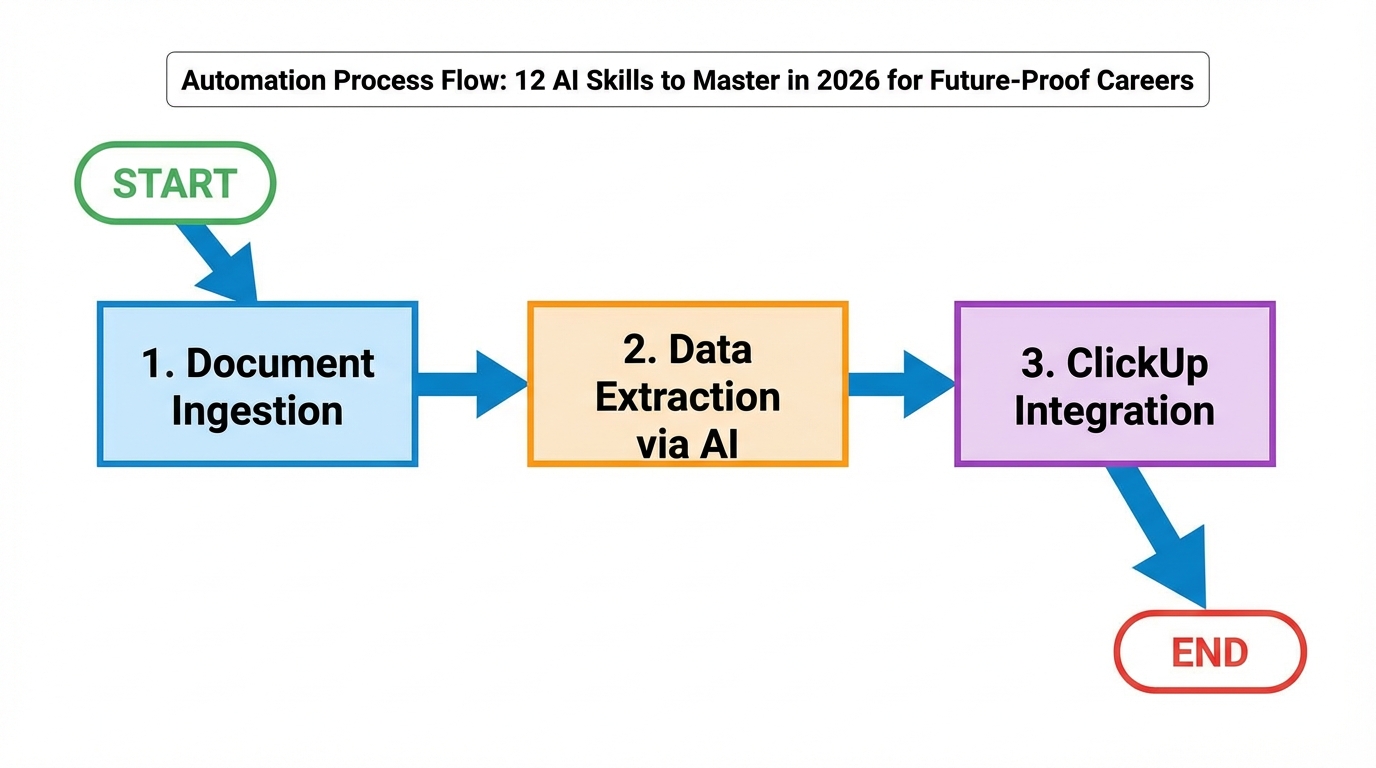
- Set up an ingestion trigger when a document arrives
- Use an AI model to extract specific field data
- Automatically push that structured output into a project management platform like ClickUp You should immediately target three administrative tasks for complete automation: cross-platform data synchronization, initial lead qualification routing, and routine status update generation. Connecting these systems eliminates manual data entry entirely.
3. Developing agentic AI systems
Cross-platform reporting often consumes an entire business day when executed manually. By building an automated workflow, you can deploy an AI agent to extract CRM data, draft an executive summary, and distribute it via email every Monday morning. Maintaining and optimizing this pipeline is the shift into agentic AI management.
You can execute multi-step goals without continuous human prompting by deploying agentic systems, which divide labor among autonomous instances. Unlike single-prompt outputs where you must dictate every sequential step, multi-agent workflows rely on frameworks like LangChain or CrewAI to divide labor. In these environments, distinct AI agents operate in tandem. One pulls the raw metrics, and another analyzes the variance to format the final narrative. This setup mirrors a human team reviewing each other's work and ensures higher fidelity in complex deliverables like financial roll-ups.
4. Implementing retrieval-augmented generation (RAG)
Building an internal knowledge base requires a secure method for an AI to query company-specific data without inventing facts. You need the model to reference your actual standard operating procedures rather than pulling generic information from its broad training data. Retrieval-augmented generation solves this exact problem by grounding the language model exclusively in your proprietary documents.
Gartner expects over 80% of enterprises will deploy GenAI-enabled applications by 2026, so this architecture is foundational. Using tools like LlamaIndex and Pinecone, you convert your company documents into vector embeddings (mathematical representations of text). When a team member asks a question, the system retrieves the most relevant embedded text blocks and feeds them to the AI to generate a precise, verifiable answer. You can keep your sensitive internal documents private with RAG, as you never need to train an external public model on your proprietary data.
5. Working with model context protocol (MCP)
Switching between your core operational software and a separate AI chat window creates unnecessary friction. Model Context Protocol standardizes how applications directly share context with AI models to bridge this gap. This protocol establishes a universal language that allows your local development environments and enterprise software to securely expose their internal state to the AI.
By adopting MCP, you integrate the AI assistant directly into your existing workspace. Whether you are using infrastructure developed by Google or custom internal dashboards, the AI can read the file you are actively working on without requiring you to copy and paste text. Context-aware interactions provide immediate benefits over isolated queries: the model understands the structural dependencies of your project and suggests modifications that align with your current operational state.
6. AI-enhanced data analysis and visualization
Traditional data analysis requires building complex pivot tables and manually writing formulas to spot trends. AI-enhanced analysis replaces this rigid process with natural language data querying, which lets you ask direct questions about your operational metrics. Instead of spending hours manipulating spreadsheets, you can simply ask the model why customer acquisition costs spiked in Q3.
You can use AI models to rapidly identify hidden correlations across massive datasets and automatically generate narrative summaries that explain the underlying drivers. You execute this workflow by feeding raw CSV files into secure, sandboxed AI environments. The system processes the data locally to produce instant, interactive visualization dashboards. As organizations realize the value of this capability, the U.S. Bureau of Labor Statistics projects employment of data scientists will grow approximately 34% over the next decade. Mastering these tools allows non-technical managers to perform advanced analytical functions independently.
7. Automating content operations and strategy
Content teams often lose hours manually analyzing competitor topics and reverse-engineering search intent for every new campaign. Automating the research phase reclaims this time and creates a more scalable production model. You must transition from viewing AI as a standalone writer to using it as a high-volume research and formatting assistant.
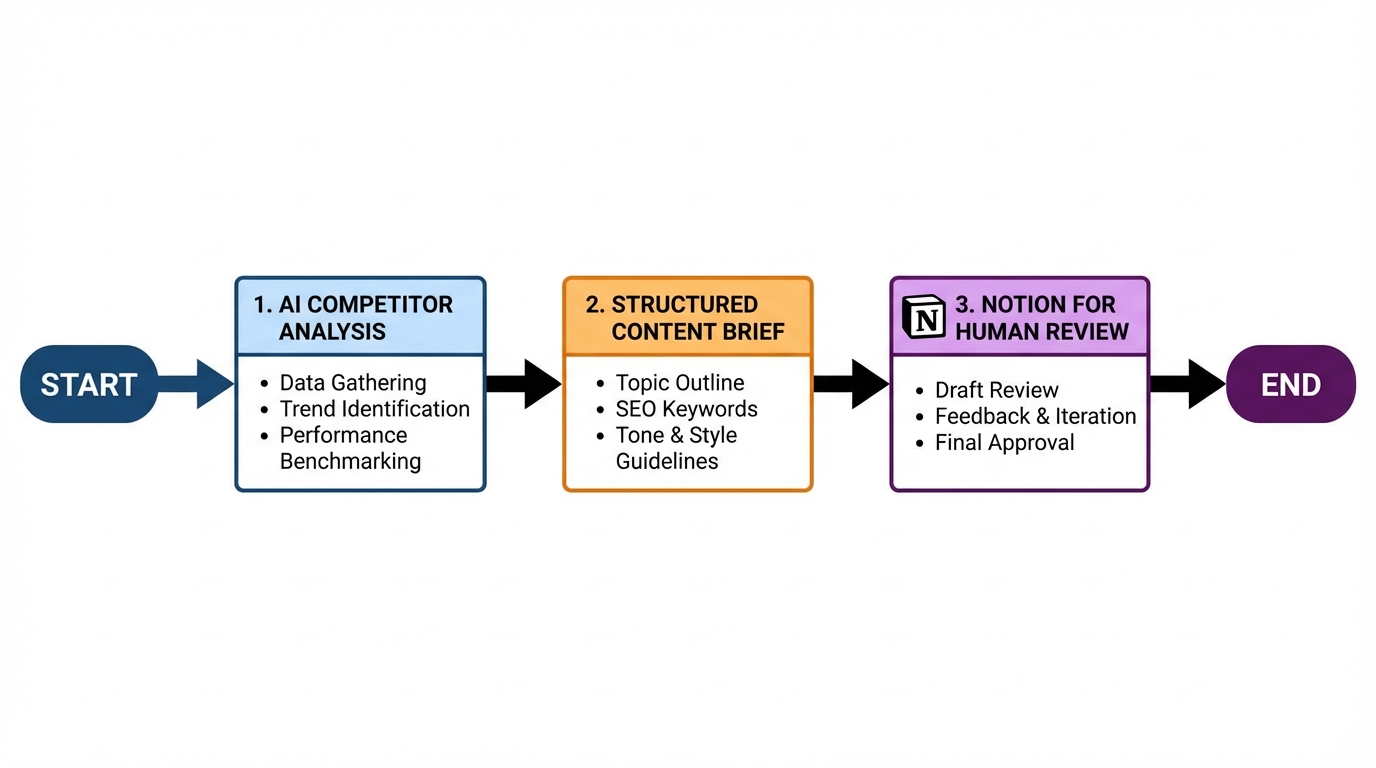
Effective automation orchestrates bulk content creation by linking distinct steps together. You can use platforms like RankDots to generate comprehensive AI content briefs based on real-time competitor analysis, then push those structured outlines into collaborative tools like Notion for human review. To maintain strict brand voice consistency across hundreds of assets, employ systemic prompts that enforce exact stylistic constraints and negative boundaries. With this systematic approach, you make the AI a strategic multiplier rather than a source of generic, off-brand content.
8. No-code and low-code AI application building
Deploying functional, custom AI tools for your team no longer requires a background in Python or machine learning engineering. The rise of visual development platforms allows operations managers to build specific AI utilities using visual interfaces rather than code. You can assemble drag-and-drop logical blocks to deploy internal AI web applications in an afternoon.
This approach democratizes AI access, so the people who understand the business problems can build the solutions. A custom no-code interface can immediately solve common administrative bottlenecks, such as standardizing messy client intake forms or automatically categorizing inbound support emails based on urgency. By wiring a form input to an API endpoint and mapping the output to a database, you create a permanent operational asset. Programming knowledge is no longer the barrier to entry for workflow automation.
9. AI security, governance, and ethics compliance
Pasting sensitive corporate financials or personally identifiable customer data into public language models introduces severe liability. Public models often use input data to train future versions, which means your proprietary strategy could inadvertently surface in a competitor's query. Establishing strict governance protocols protects your organization from these massive security blind spots.
When evaluating enterprise-grade AI vendors, require a strict checklist:
- Zero-day data retention policies
- Explicit opt-outs for model training
- Role-based access controls
- SOC 2 compliance verification Implementing observability tools like Helicone or TruLens allows you to monitor exactly what data flows in and out of your internal AI systems. Regularly auditing model inputs and outputs prevents systemic bias from creeping into automated decision-making processes, such as resume screening or vendor selection. Proper governance transforms AI from a security risk into a compliant operational advantage.
10. Predictive analytics and forecasting
Standard operational reporting only tells you what happened last month and leaves you to guess what will happen next. Integrating machine learning into your workflows transitions your reporting from reactive historical analysis to proactive future probability forecasting. You start anticipating market movements rather than simply recording them.
You can use predictive analytics models to analyze historical patterns alongside external variables to assign concrete probabilities to future events. In inventory management, this powers highly accurate demand forecasting that prevents both stockouts and capital tie-ups. Within sales pipelines, predictive lead scoring analyzes behavioral signals to flag which prospects are most likely to close this quarter. The core business advantage lies in acting on algorithmic trend identification before your competitors even recognize the shift. Operational leaders who can operationalize these predictions secure a distinct margin advantage.
11. Conversational AI and customer experience optimization
Users often abandon legacy rule-based chatbots because they trap them in rigid decision trees that fail the moment a query deviates from the script. Modern conversational agents, powered by the architecture behind tools like ChatGPT, understand semantic intent and maintain context throughout a multi-turn conversation. This shift transforms automated support from a cost-cutting nuisance into a genuine value driver.
Deploying an effective agent requires a structured workflow: ingest your entire library of product documentation and instruct the model to resolve tier-1 support tickets using only verified company data within strict behavioral guardrails. To ensure a positive customer experience, integrate real-time sentiment analysis into the system. When the model detects rising user frustration or identifies a complex edge case, it triggers an immediate, structured handoff to a human representative and passes along the full conversation history.
12. Continuous AI model fine-tuning
When your AI needs to write exactly like your senior copywriter, standard knowledge retrieval isn't enough. You need fine-tuning to adapt pre-trained models on your specific historical outputs to change how they write, code, or classify information. You use platforms like Hugging Face to train open-source models specifically on your historical successful outputs.
An organization should choose fine-tuning over RAG when the goal is improving the format, tone, and specific stylistic behavior of the model, rather than just updating its factual knowledge. To maintain this performance as your business logic changes over time, you must establish continuous feedback loops. This involves logging model outputs, having human experts grade those responses, and periodically retraining the model on the corrected dataset to prevent conceptual drift.
AI tool integration methods: native vs. iPaaS vs. custom API
| Integration Method | Technical Difficulty | Security Considerations | Maintenance Burden | Best Use Case |
|---|---|---|---|---|
| Native Integration | Low (Plug-and-play configuration) | Low (Data encrypted and managed by the platform vendors) | Minimal (Vendors handle API updates) | Standard data syncing between established marketing and AI platforms |
| iPaaS (e.g., Zapier, Make) | Medium (Requires webhook and logical mapping knowledge) | Medium (Introduces a third-party processor to the data pipeline) | Moderate (Requires monitoring for broken connections) | Rapidly connecting AI tools without native support |
| Custom API Development | High (Requires dedicated software engineering resources) | High (Requires custom authorization protocols and security audits) | High (Requires ongoing developer support for API versioning) | Complex, proprietary data transformations and high-volume LLM routing |
Industry and role applications for AI mastery
AI mastery is no longer restricted to software developers and data scientists. The line between technical engineering and operational management continues to blur as accessible tools allow business leaders to build custom automated solutions. Mastering these skills translates directly into high-impact results across finance, marketing, and standard daily operations.
In finance, algorithmic analysis rapidly processes complex regulatory text. Bloomberg reports that JPMorgan Chase automated 360,000 hours of work a year using their COiN platform to analyze commercial loan agreements. In marketing, these capabilities orchestrate cross-channel campaigns at scale, while operations teams deploy agents to resolve supply chain bottlenecks automatically. The financial incentive for mastering these systems is substantial; AI engineers command highly lucrative compensation packages. Professionals who can bridge the gap between business strategy and automated execution hold a strong advantage in the modern labor market.
Your 2026 upskilling and action plan
Watching endless tutorial videos without building functional systems will not secure your career. You must execute a concrete 30-60-90 day learning roadmap focused entirely on deploying real operational workflows. During the first 30 days, identify one specific manual reporting task and use advanced prompt engineering to format the data automatically. By day 60, connect two distinct platforms via an API layer to eliminate a data entry bottleneck. At the 90-day mark, implement a basic RAG system that queries your team's standard operating procedures.
Hiring managers heavily prioritize demonstrable project portfolios over theoretical certifications. Being able to show a functioning automated pipeline that saves your current team ten hours a week proves your practical competence. This direct application of technology translates directly into wage premiums and leadership positioning. Research from PwC indicates workers with AI skills commanded a 56% higher pay premium. While earlier Glassdoor data pegged average base pay for AI engineers near $132,855, recent market shifts suggest even higher ceilings for professionals who combine operational expertise with technical execution. Focus on building assets, not just accumulating badges.
Conclusion and final thoughts
True technological proficiency is measured by tangible revenue impact and hours saved, not by your total prompt count. Mastering these 12 AI skills requires moving past theoretical curiosity and committing to structural implementation. You build a resilient career by continually adapting to new efficiencies rather than resisting them.
Select one specific, recurring workflow to automate this week, such as categorizing incoming vendor emails or formatting weekly metric updates. Deploy a basic automation layer to handle it, and track the manual hours you save by Friday.
Frequently asked questions
What are the main areas and types of AI?
How will the AI job market evolve by 2026?
What is the best practical AI skill for beginners to learn first?
Automate your keyword intent analysis
Replace manual keyword categorization with automated intent detection. Apply your AI skills to build workflows that classify informational and commercial queries instantly, reducing your research time and increasing content relevance.